
By AI Peak Biz Team · June 29, 2026
The Role of AI in Service Call Management

AI-powered call management is defined as the use of automated voice agents and natural language processing to handle inbound calls, qualify leads, and book appointments without human intervention. Service businesses lose revenue quietly every day through missed calls. Small-to-medium businesses miss 27% to 40% of inbound calls on average. The role of AI in service call management is to close that gap by answering calls, capturing leads, and booking appointments around the clock. AI Peak Biz was built specifically to help service businesses that cannot afford to lose customers to missed calls.
How does AI improve missed call recovery and lead capture?
Missed calls are not just an inconvenience. Each missed call can represent lost revenue, depending on your industry and customer lifetime value. A plumbing company missing five calls on a Saturday afternoon could lose thousands of dollars before Monday morning.
Traditional answering systems capture only a small share of missed call opportunities. AI front desks that answer within one to two rings can capture more of them. That is not a marginal improvement. It is a structural change in how revenue flows into your business.
The process works in a clear sequence:
- The AI detects an inbound call and answers within one to two rings.
- It greets the caller with a natural, conversational voice, not a rigid IVR menu.
- It asks qualifying questions: service type, location, urgency, and contact details.
- It books the appointment directly into your calendar or CRM.
- It logs the lead record automatically for follow-up.
AI voice agents can turn some of the calls they answer into booked work. Compare that to a voicemail system where most callers simply hang up and call your competitor. The difference is live, interactive booking versus passive message collection.
Pro Tip: Connect your AI call system directly to your CRM from day one. Leads that enter a CRM within minutes of first contact convert at significantly higher rates than those logged hours later by a human.

What are the key operational benefits and cost savings?
The financial case for AI in customer service is straightforward. A full-time human receptionist costs roughly $3,000 per month in salary alone, before benefits, training, and turnover costs. AI systems operate at 10 to 30% of that cost while handling a higher volume of calls without fatigue or sick days.
Beyond cost, AI handles the repetitive work that consumes your team's time. AI can automate many initial contact center interactions, including FAQs, appointment scheduling, and status updates. That frees your human staff to focus on complex jobs, upselling, and customer relationships that actually require judgment.
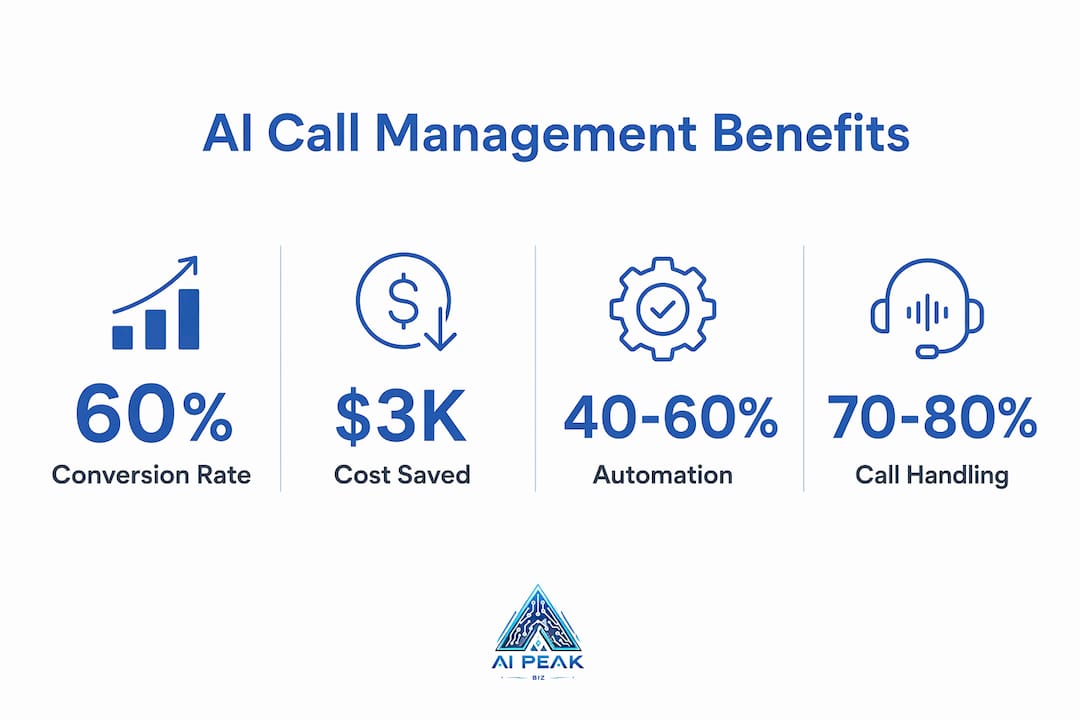
Automation reduces call wait times and gives staff the space to handle cases that need real expertise. Customers who reach a human agent faster, because routine calls are handled by AI, report higher satisfaction. The operational math is simple: fewer hold times, better allocation of human talent, and lower overhead.
Pro Tip: Do not eliminate your human team when you add AI. The best results come from a hybrid model where AI handles volume and humans handle value. Your staff will thank you, and so will your customers.
What challenges should you consider when integrating AI into call workflows?
AI integration fails most often when businesses try to automate everything at once. The right approach is narrow, focused, and measurable. Start with a single predictable workflow like appointment scheduling, and build from there.
A structured rollout follows these steps:
- Identify your highest-volume, most repetitive call type. Appointment booking and FAQ calls are ideal starting points.
- Set up a human-in-the-loop review process. Have a team member audit AI interactions daily for the first 30 days. This builds trust and catches errors early.
- Define clear escalation triggers. Angry callers, billing disputes, and complex service issues should route to a human agent immediately.
- Measure conversion, not just call volume. Track how many AI-handled calls result in booked appointments versus dropped interactions.
- Expand gradually. Once appointment scheduling runs cleanly, add lead qualification, then follow-up texts, then status update calls.
One critical distinction separates high-performing AI deployments from mediocre ones. Call deflection is not the same as conversion. Routing a caller to voicemail or a callback queue is deflection. Booking an appointment during the live call is conversion. Your AI system must aim for conversion, not just deflection.
Managing customer expectations matters too. Callers do not need to know they are speaking with an AI, but they do need a clear path to a human if the conversation goes beyond the AI's scope. A smooth handoff, with context passed to the human agent, prevents frustration and builds trust.
Pro Tip: Build your AI's knowledge base before launch. A well-constructed script covering your top 20 most common questions will resolve issues faster and keep callers from asking to speak with a human unnecessarily.
How do hybrid AI-human models improve customer experience?
A practical call management model is a hybrid approach where AI handles routine calls and human agents handle complex cases requiring empathy or authority. This is not a compromise. It is the most effective structure available to service businesses today.
Here is what the hybrid model looks like in practice:
- AI handles: appointment booking, service area questions, pricing FAQs, call-back scheduling, and status updates.
- Human agents handle: complaints, contract negotiations, emergency escalations, and situations where a caller is distressed.
- Handoff protocol: The AI passes a full call summary and lead record to the human agent before the transfer completes. The human never starts from zero.
AI voice agents understand natural language and integrate with CRM and scheduling systems for real-time processing. This means the AI does not just collect information. It acts on it immediately, entering data, booking slots, and sending confirmation texts before the call ends.
AI delegates routine tasks so human agents can focus on high-value work requiring judgment and expertise. An HVAC company using this model, for example, lets AI handle all scheduling calls during peak season while human technicians focus on diagnosing complex system failures. The result is faster response times, higher booking rates, and a team that is not burned out by repetitive phone work. AI Peak Biz builds this exact structure into its AI voice assistant platform for service businesses.
Key takeaways
AI in service call management delivers the highest return when deployed in supervised, measurable workflows that combine automated volume handling with human judgment for complex cases.
| Point | Details |
|---|---|
| Missed call recovery | AI front desks can capture more calls that would otherwise be missed. |
| Cost efficiency | AI systems can cost less than added staff while automating many routine interactions. |
| Conversion over deflection | AI must book appointments during live calls, not redirect to voicemail, to maximize revenue capture. |
| Hybrid model wins | AI handles routine calls; human agents handle complex, empathy-driven interactions. |
| Start narrow | Deploy AI on one predictable workflow first, review results with a human, then expand gradually. |
What I have learned from watching businesses deploy AI in their call workflows
Most business leaders I talk to approach AI call management with one of two wrong assumptions. The first is that AI will replace their front desk entirely. The second is that it is too complicated to be worth the effort. Both assumptions cost money.
The businesses that see real results start small and stay disciplined. They pick one workflow, usually appointment scheduling, and they measure it obsessively for 30 days. They do not declare victory after week one. They watch the data, fix the edge cases, and then expand. That patience is rare, and it is exactly what separates the businesses that recover revenue from the ones that buy a tool and abandon it.
The missed call problem is more expensive than most managers realize. Revenue leaks quietly. A call at 7 p.m. on a Tuesday that goes to voicemail is almost never returned by the caller. That is a lost job, a lost relationship, and a lost referral. AI does not get tired at 7 p.m. It answers, qualifies, and books. That consistency is the real value, not the technology itself.
Many businesses also overcomplicate their setup by trying to automate every possible scenario before launch. The result is a system that handles nothing well. Keep the initial scope tight. Get one workflow running cleanly. Then build. The AI tools improving customer experience that actually stick are the ones that solve one specific, painful problem first.
How AI Peak Biz helps service businesses recover revenue from missed calls
Service businesses that miss calls do not just lose a single transaction. They lose the lifetime value of a customer who called once and never tried again.

AI Peak Biz provides an AI voice assistant built specifically for service businesses. It answers calls instantly, qualifies leads, and books appointments 24 hours a day, 7 days a week. The system can connect to your calendar, so leads are captured and appointments confirmed with less manual effort. For businesses ready to stop losing revenue to unanswered calls, AI Peak Biz also offers an AI appointment setter that handles the full booking workflow from first contact to confirmed job. No missed calls. No lost leads. No revenue left on the table.
Recommended
- AI in Home Service Businesses: Your 2026 Guide | AI Peak Biz
- The Role of AI in Patient Communication: 2026 Guide | AI Peak Biz
- AI Voice Assistant for HVAC Companies: 24/7 Call Handling That Books Jobs | AI Peak Biz
- AI Answering Service vs. Traditional Answering Service: Which Is Right for Your Business? | AI Peak Biz
FAQ
What is AI call handling?
AI call handling is the use of automated voice agents to answer inbound calls, respond to customer questions, and book appointments without a human receptionist. These systems use natural language processing to understand callers and act on their requests in real time.
How does AI help with missed call recovery?
AI front desks answer calls within one to two rings and capture lead information immediately. This prevents callers from hanging up and contacting a competitor.
What is the role of AI in service call management for small businesses?
AI in service call management automates routine interactions like scheduling and FAQs.
Should AI fully replace human agents in a call center?
No. A common model has AI handling routine calls while human agents manage complex, sensitive, or high-stakes interactions. Full automation without human oversight leads to poor customer experience on edge cases.
How do I measure whether AI call management is working?
Track appointment booking rate, call capture rate, and lead-to-job conversion rate before and after deployment. A well-configured AI system should show measurable improvement in all three within the first 30 days of operation.