
By AI Peak Biz Team · September 11, 2026
AI Answering Service Cost: What You're Actually Paying For

Many small businesses pay a moderate monthly fee for an AI answering service, with premium and hybrid plans available at higher prices. The number that matters most isn't the sticker price on a pricing page. It's how the vendor bills your calls, how many calls you actually get, and how long your average call runs. AI answering usually costs less than a live receptionist, but you only capture the savings if the system is actually wired into your booking calendar.
TL;DR:
- Per-minute billing benefits businesses with short, high-volume calls but can become costly if calls run long or exceed bundles.
- Hybrid plans price higher but can reduce overall costs by handling most routine calls automatically and only escalating complex issues to a human agent.
- AI answering service prices vary widely, with pricing heavily influenced by included minutes, features, and overage charges.
- Accurate cost estimation requires analyzing past call volume, call length, seasonal spikes, and planned call handling features before selecting a plan.
- Optimizing for booked appointments instead of answered calls can significantly lower effective costs through better integration with calendars and CRM systems.
Table of Contents
- AI Answering Service Cost at a Glance: What Each Tier Buys
- Pricing Models Explained: Per-Minute, Per-Call, Flat, and Hybrid
- What Actually Drives Your AI Receptionist Pricing
- AI vs. Live Answering vs. Hybrid: What Each Option Actually Costs You
- How to Calculate Your Expected Monthly AI Answering Bill
- Why the Real Cost Is Lower Than the Invoice Suggests
- Three Priorities That Matter More Than the Sticker Price
- Try AI Peak Biz Before You Commit to a Plan
- Sources
AI Answering Service Cost at a Glance: What Each Tier Buys
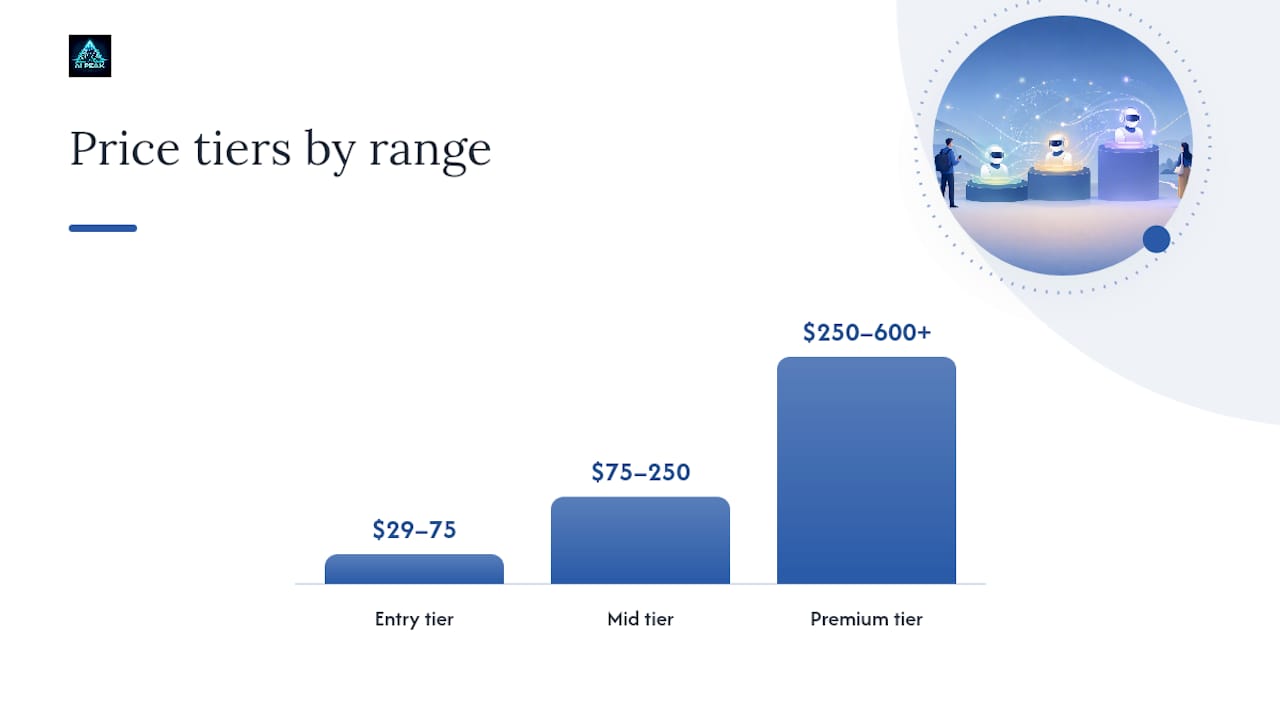
The price you pay tracks closely with what the plan can actually do once someone calls. Here's how the tiers break down in practice.
- Entry plans: Small minute bundles or a capped number of calls, basic message-taking, and voicemail transcribed to text. Fine for a business fielding a handful of calls a week, but overage costs stack up fast once volume grows.
- Mid-range plans: Larger minute allowances, real calendar booking instead of just message-taking, and integrations with mainstream calendar and CRM tools. Overage rates here tend to be more reasonable per minute than entry tiers.
- Premium and enterprise plans: Higher call capacity, multi-location support, bilingual answering, and dedicated onboarding to configure call flows and scripts around your specific service.
Standalone AI receptionist plan prices vary widely, depending mostly on included minutes and feature depth. Prices climb further once you add hybrid coverage, where a human takes over for calls the AI can't resolve. Hybrid plans typically have higher prices since they include both AI and human labor.
A few line items outside the base plan are worth watching before you sign anything: human escalation fees when a call gets routed to a live agent, per-call scheduling charges on top of the base plan, and per-location pricing if you run more than one office or service area. None of these are dealbreakers, but they may affect the final amount on your invoice.
Pricing Models Explained: Per-Minute, Per-Call, Flat, and Hybrid
Every AI answering service bills you one of four ways, and picking the wrong one for your call pattern is the single most common way businesses overpay.
- Per-minute billing. You buy a bundle of minutes and get charged an overage rate once you exceed it. This model favors businesses with short, high-volume calls, like a plumbing dispatcher fielding quick scheduling requests. It punishes you when calls run long, since every extra minute of a rambling customer conversation hits your bill directly.
- Per-call billing. You pay a flat fee per answered call regardless of length. This gives you predictable costs when your calls are naturally brief, but it can get expensive fast if your business handles detailed intake calls, like a home renovation estimate that runs 12 minutes. Ask vendors exactly how they define a "call" for billing purposes; some count transfers or callbacks as separate billable events.
- Flat monthly or unlimited billing. You pay one fixed price no matter how much you use the service. This looks safest on paper, but check the fair-use terms closely. If you're only fielding 40 calls a month, your effective cost per call might actually be higher than a per-minute plan would have charged you.
- Hybrid billing. The AI handles the first pass on every call, and human agents step in for anything the system flags as complex or high-stakes. Billing usually splits into a base AI fee plus a per-escalation charge for human handling, which is why hybrid plans carry the highest headline prices in the market.
Pro Tip: Pull three months of call logs from your phone system before you compare plans. If your average call length varies wildly month to month, a flat or hybrid model protects you better than per-minute billing ever will.
What Actually Drives Your AI Receptionist Pricing
Four factors decide what you'll actually pay, and three of them are things you can measure yourself before you ever talk to a sales rep.
- Call volume and average call length. Most phone systems and VoIP dashboards already log this. Pull a report covering a normal month and a busy month, not just your slowest week, so your estimate reflects reality.
- Feature premiums. Booking directly into your calendar, collecting payment over the phone, offering bilingual support, and connecting to your CRM through an API all typically cost more than basic message-taking. Multi-location businesses often pay a per-location fees on top of the base plan.
- Billing mechanics. Ask how the vendor rounds call time. Some bill in 60-second increments, others in 6-second increments, and that difference alone can shift your effective rate by several percentage points over a busy month.
- Seasonal spikes. A landscaping company's April call volume looks nothing like its December volume. Build a budgeting buffer into your estimate rather than pricing off your average month, especially if your business has an obvious peak season.
Reviewing how overflow inquiries get routed matters here too, since a system that handles spillover calls efficiently keeps your per-call cost from creeping up during your busiest weeks.
AI vs. Live Answering vs. Hybrid: What Each Option Actually Costs You
The cheapest option on paper isn't always the cheapest option once you factor in what gets missed. Here's how the three approaches actually compare.
- AI answering works best for routine, predictable traffic: appointment requests, hours and location questions, simple rescheduling. It's the clear economic choice when most of your calls follow a script you could write down in five bullet points.
- Live human answering still wins for complex intake, emotionally sensitive calls, or anything involving legal nuance, where a person needs to read tone and improvise. Traditional answering services typically charge substantially more per minute than AI options, which is the trade-off you're making for that human judgment.
- Hybrid answering splits the difference, letting AI clear routine calls while routing the rest to a live agent. It costs more than pure AI but less than an all-human service, provided your call volume doesn't push escalation rates too high.
The better question isn't which option answers the most calls. It's which option completes the most bookings. A service that answers 200 calls but only books 40 appointments is worth less than one that answers 150 calls and books 60, and the data on omnichannel customer experience backs this up: businesses that connect the answering step directly to booking and follow-up systems retain more of the customers they engage. Weigh cost per completed action, not cost per answered call, when you compare vendor quotes.
How to Calculate Your Expected Monthly AI Answering Bill
You don't need a finance degree to model this. You need four numbers and about ten minutes with your phone system's call log.
- Gather your inputs. Pull total calls for a typical month, your average call length in minutes, the percentage of calls that need a booking or scheduling action, and your peak call windows.
- Choose your billing model based on that data. High call count with short average length favors per-minute. Long, detailed calls favor flat or hybrid.
- Apply the rate. Multiply your monthly minutes (or call count) by the vendor's published rate, then add the base subscription fee if the plan has one.
- Add your overage buffer and extras. Vendor guidance commonly recommends padding your estimate to cover call spikes, plus any per-location or integration fees.
Here's the math in action. Business A takes 300 calls a month averaging 2 minutes each, 600 total minutes, on a per-minute plan billing $0.35 per minute past a 300-minute bundle. That's roughly 300 overage minutes at $0.35, or about $105 above the base fee. Business B takes the same 300 calls but averages 5 minutes each, 1,500 minutes total. On the same plan, that's 1,200 overage minutes, or $420 above the base fee, four times the overage cost from a 3-minute difference in average call length. That gap alone should tell you why average call length matters more than most vendor sales pages let on. For a deeper walk-through of turning captured calls into revenue, the AI ROI calculation guide breaks down the same math from the revenue side.
Why the Real Cost Is Lower Than the Invoice Suggests
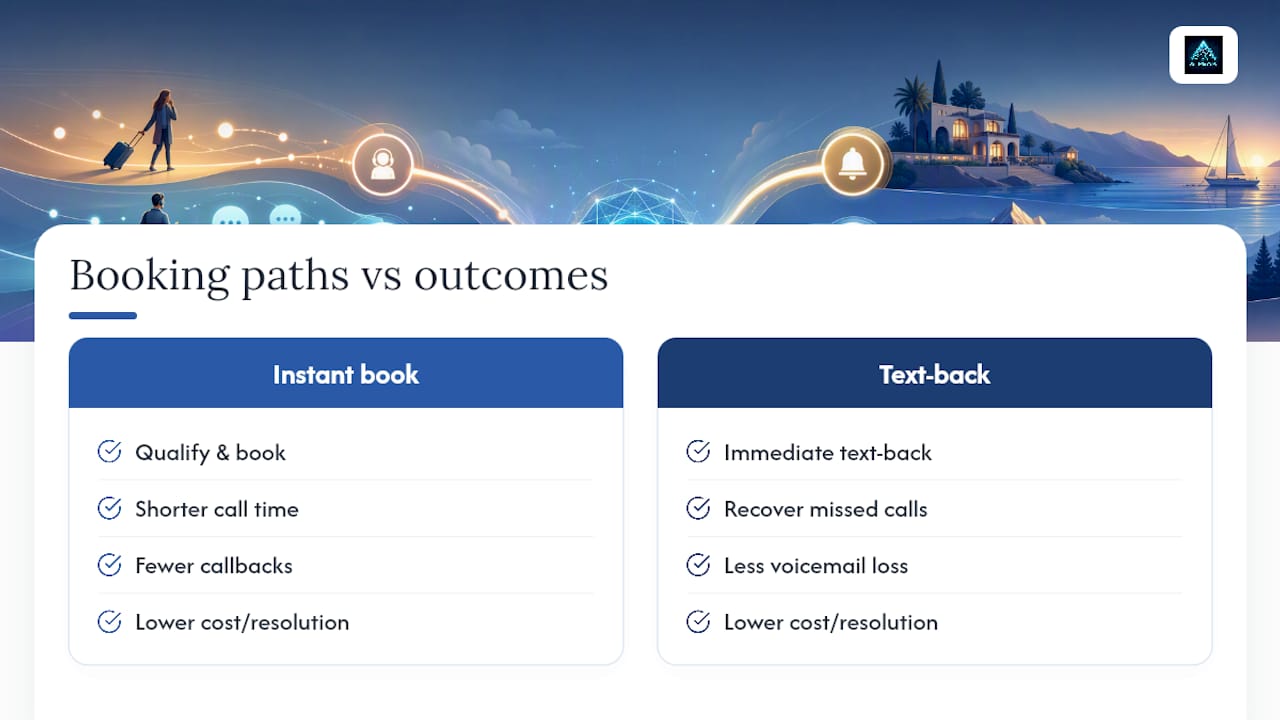
The invoice only tells half the story. What actually determines your cost per resolved call is how many of those calls turn into a booked appointment without a callback, a voicemail, or a second conversation. Some AI answering services answer calls and book appointments by phone, which can shorten the average call and lower effective minutes per resolution. Missed-call text-back closes the gap on calls you'd otherwise lose entirely, turning a hang-up into a booked job instead of a line item you never see. Tight CRM and scheduling integration means the AI isn't just answering, it's finishing the job the call was for in the first place, which is where the real revenue recovery happens.
Three Priorities That Matter More Than the Sticker Price
Before you compare quotes, measure your baseline: how many calls are you actually missing today, and what's a missed booking worth to your business? That number should anchor every pricing conversation you have with a vendor.
Match the billing model to your real call pattern instead of the vendor's example month. If your calls run long and unpredictable, a per-minute plan will quietly punish you every time. And insist on a short live trial with real traffic before signing anything. Ask the vendor to spell out overage rules in writing, not verbally, so nothing surprises you on invoice one.
Try AI Peak Biz Before You Commit to a Plan
Some vendors offer systems built to answer calls and book appointments by phone, which can help lower the real cost per booked job rather than having it hidden inside an overage bill.
During any trial, watch three things closely: your actual booking completion rate, how long integration with your calendar and CRM takes to go live, and exactly how the vendor handles overage once you exceed your bundle. Those three answers tell you more about real cost than any pricing page will. AI Peak Biz's appointment-setting AI is built around that exact job, capturing the call, qualifying the lead, and locking in the booking without a second touch. If you want the specific numbers for your call volume, check the pricing page or request a demo to see how it handles your actual traffic before you sign anything.
Sources
Recommended
- AI Answering Service vs. Traditional Answering Service: Which Is Right for Your Business?
- What Is an AI Answering Service? A 2026 Guide
FAQ
Is There a Free AI Answering Service?
Most providers offer a free trial period rather than a permanently free tier, since running AI voice and phone minutes carries real usage costs that scale with your call volume.
Is an AI Receptionist Worth It?
For businesses losing bookings to missed calls or slow follow-up, yes. The math usually favors AI once you account for recovered appointments, not just the subscription fee, especially when integration lets the system complete the booking instead of just taking a message.
What's the Best AI Answering Service?
The best option depends on your call volume and average call length rather than any single "best" plan. Services like AI Peak Biz combine fast call and text response with direct booking. Compare completed appointments per dollar, not just answered calls.
Which AI Receptionist Is the Cheapest?
Entry-level AI plans are the cheapest on paper, but they usually come with small minute bundles and steep overage rates. A mid-tier plan with a larger bundle often ends up cheaper overall once you factor in your real call volume.