
By AI Peak Biz Team · August 28, 2026
Customer Reactivation Campaigns for Service Marketers: 5 Touch RFM

A customer reactivation campaign is a sequenced, multi-channel effort to win back customers who have stopped buying, booking, or responding. Done right, a reactivation campaign can win back some dormant customers, and you can measure the return against what it cost to run. Start with a data audit this week, then build one segmented sequence before you touch anything else.
TL;DR:
- Reactivation campaigns can win back a share of dormant customers; measure your own recovery rate and return against your baseline.
- Segmentation based on RFM scores, last activity, and payment status prioritizes high-value, recent inactive customers and aligns messaging accordingly.
- A five-touch, multi-channel sequence over 21 days, starting with value-driven contacts and escalating to incentives and urgency, outperforms single-discount blasts.
- Avoid leading with discounts to protect margins and tailor offers with expiration dates of 48 to 72 hours to encourage timely response.
- Automating follow-up and qualification with AI can significantly increase revenue recovery and reduce staff workload, especially for small teams.
Table of Contents
- Why Reactivation Campaigns Matter More Than New Customer Acquisition
- How Do You Segment Dormant Customers for Reactivation?
- What's the Right Sequence and Timing for a Win-Back Flow?
- How Should You Structure Discounts and Offers?
- How Do You Measure Whether a Reactivation Campaign Worked?
- What Mistakes Damage Reactivation Campaigns Most?
- Example: How Automated Follow-Up Can Recover Revenue
- What Should a Small Team Actually Launch First?
- How AI Peak Biz Runs Reactivation Campaigns Without the Manual Grind
- Sources
Why Reactivation Campaigns Matter More Than New Customer Acquisition
Winning back a dormant customer costs a fraction of what it takes to acquire a new one, because you already have their contact information, purchase history, and a working relationship you don't have to build from zero. That's the entire economic case for reactivation.
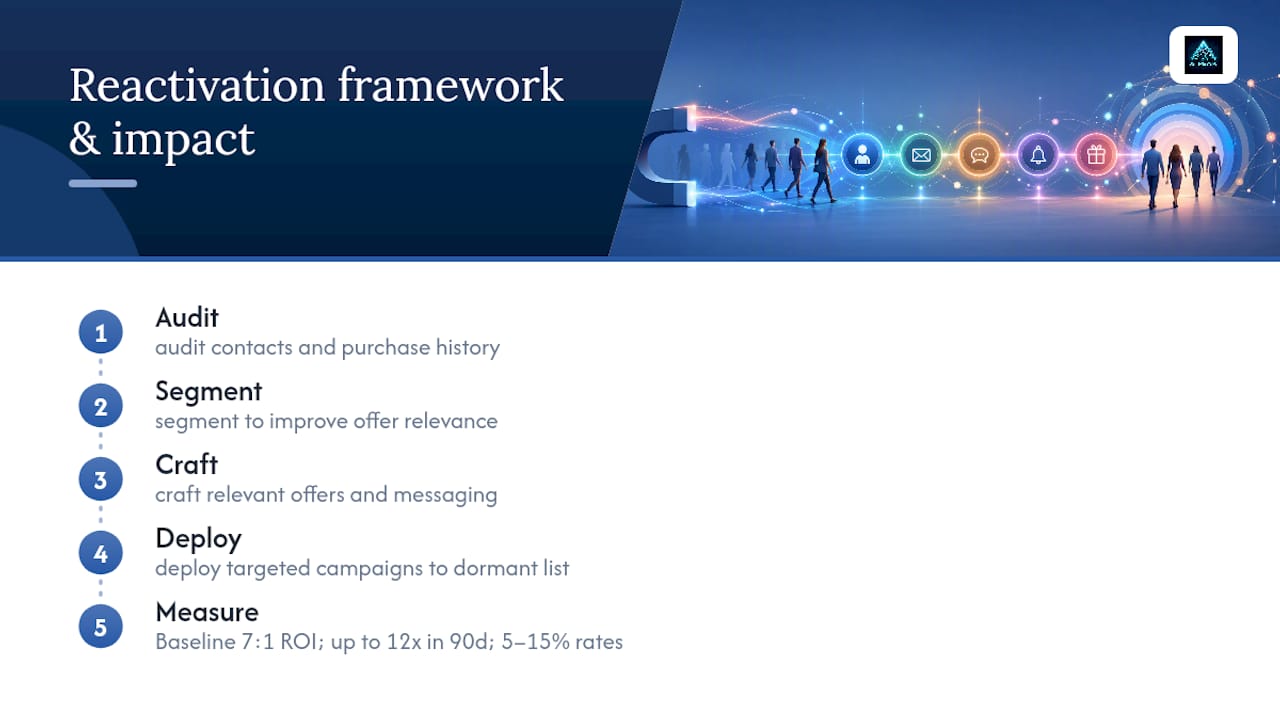
The numbers back it up. A structured five-step framework of audit, segment, craft, deploy, and measure gives you a repeatable way to run reactivation and measure its return. How many dormant customers come back depends on how long they've been gone and how relevant your offer is.
Pro Tip: Reactivation delivers the biggest leverage when you have a large dormant list paired with a historically high average order value. If your business skews low-ticket and low-repeat, put your energy into acquisition instead.
How Do You Segment Dormant Customers for Reactivation?
Before you write a single email, audit your list. Check three things: contact quality (valid email or phone), last activity date, and payment or account status, since billing failures often masquerade as disengagement.
Once the list is clean, apply RFM scoring, recency, frequency, and monetary value, to rank who's worth pursuing first. This is the segmentation method that separates campaigns generating real ROI from ones that just spam everyone equally.
Practical cutoffs that work for most service businesses:
- Golden Dormant: high past spend, inactive 60 to 120 days. Priority one, personal outreach, light discounting.
- Fading Regulars: moderate spend, consistent past frequency, now quiet 30 to 90 days. Priority two, automated sequence with a mid-tier offer.
- Long-Tail Low-Value: minimal spend, inactive over 180 days. Light-touch or straight to sunset.
Then map churn reason to campaign type. Price-sensitive customers need value reinforcement before any discount. Product-gap churners need a "here's what's new" message. Experience-related churn (a bad appointment, a missed call) needs a direct acknowledgment, sometimes a personal note from an owner. Involuntary churn, expired cards, failed payments, needs a simple, frictionless fix, not a marketing pitch.
What's the Right Sequence and Timing for a Win-Back Flow?
An escalating, multi-touch flow beats a single discount blast because it builds a reason to return before it asks for money. Progressive disclosure, leading with value, escalating to incentive, preserves margin and pulls in more net revenue than jumping straight to a coupon.
Here's a five-touch sequence that works for most service businesses, timed to a 21-day active window following pre-winback engagement research showing a nudge around day 30 of inactivity reduces full lapse:
- Day 1, soft nudge (email): "We miss you" tone, no offer. Acknowledge the gap, ask what changed.
- Day 5, value update (email + SMS for Golden Dormant): Share a product update, new service, or relevant social proof.
- Day 10, personalized recommendation (email): Reference their specific past purchase or appointment history.
- Day 15, incentive (email + SMS): Introduce the offer, sized to segment.
- Day 21, urgency/last chance (SMS + retargeting ad): Clear deadline, final nudge before suppression.
Channel logic matters here. Email carries the first three touches because it's low cost and easy to personalize. Escalate to SMS once you introduce the offer, since text open rates hold up even after email engagement has died. For B2B accounts, swap SMS for LinkedIn outreach on the incentive and urgency touches, a channel with outsized leverage when the contact is a decision-maker rather than a consumer.
A few sequencing notes worth keeping in your back pocket:
- Retargeting ads work well as a parallel track, not a replacement, for email and SMS.
- WhatsApp performs strongly in markets where it's the default messaging app; treat it like SMS in the sequence.
- Never launch touch four (the offer) to a segment that hasn't opened either of the first two messages, switch channel instead.
How Should You Structure Discounts and Offers?
Lead with a discount and you teach every customer to wait for one before buying again. That's the single most expensive mistake in reactivation marketing, and it shows up in margin erosion for months after the campaign ends.
Follow a progressive-disclosure rule: touches one and two carry no offer at all, just value and relevance. The incentive appears on touch four, and even then, size it by segment rather than blasting one flat discount to everyone.
- Golden Dormant: early access, a free upgrade, or a personal call from an owner, not necessarily a discount.
- Fading Regulars: a modest percentage-off or a bundled add-on.
- Long-Tail Low-Value: your steepest offer, since you're weighing conversion against the cost of continuing to hold the contact.
Pro Tip: Attach a real expiration date to every offer, 48 to 72 hours works well, and mean it. A discount that "expires" but keeps working when someone uses it late trains customers to ignore your deadlines entirely.
How Do You Measure Whether a Reactivation Campaign Worked?
Track four numbers: reactivation rate (percentage of the dormant segment that took action), revenue recovered, cost per reactivated customer, and 90-day retention. That last metric is the one most teams skip, and it's the one that tells you whether you recovered a customer or just a single transaction. Reactivated customers frequently spend more than their historical average on that first return purchase, which makes short-window reporting misleading if you stop measuring at day 30.
Attribute revenue to the specific touch that triggered the return, not just the campaign overall, so you know which segment and message combination to repeat next quarter.
What Mistakes Damage Reactivation Campaigns Most?
The three most common failures: leading with a discount instead of value, sending one generic blast to the entire dormant list, and ignoring why a customer left in the first place. Skip churn-reason mapping and you'll send a price-based offer to someone who left over a bad experience, which reads as tone-deaf rather than helpful.
Deliverability hygiene protects your ability to run this campaign again. Suppress non-responders after 90 to 180 days or three to four failed touches, or your sender reputation takes the hit for every future send, including to customers who are actually active. Consider an email list hygiene review alongside your reactivation audit.
- Send a short, two-question survey before final suppression, "what would bring you back?" often surfaces the churn reason you missed.
- Build an opt-down step (fewer emails, SMS only) before full suppression, some contacts want less contact, not zero.
Pro Tip: Treat suppression as a policy, not an afterthought. Decide your timeline before you launch, or you'll end up arguing about it mid-campaign when the data is already telling you what to do.
Example: How Automated Follow-Up Can Recover Revenue
Here is how it can work. An automated sequence combines text and call follow-up with lead requalification, so no one has to dial by hand.

Automation handled the volume work: instant call and text response, lead qualification questions, and follow-up timing across the full sequence. Human judgment stayed in the loop for offer design and reviewing which segments needed a personal touch instead of an automated one. That split, machines on speed and consistency, people on strategy, is the practical framework worth copying regardless of which tools you use.
What Should a Small Team Actually Launch First?
If you're running this with limited hands, do three things in order: audit your list this week, build one segmented sequence (start with Golden Dormant only), and hold every judgment about scaling until you've measured 90 days of retention data, not 30.
Bring in AI or a vendor once manual follow-up becomes the bottleneck, not before. Automation should absorb repetitive volume work, not replace the offer strategy and segment decisions that actually drive the ROI difference between 3:1 and 12x campaigns.
How AI Peak Biz Runs Reactivation Campaigns Without the Manual Grind
AI Peak Biz replaces the manual grind of this entire playbook with an AI front desk that answers calls and texts fast, qualifies the lead, and books the appointment, so dormant contacts do not sit in a spreadsheet waiting for someone to find time.

The platform executes the pieces that eat the most staff hours: automated follow-up sequences across your dormant list, missed call text-back, and appointment scheduling that runs whether your team is on the phone with another customer or asleep. For service businesses without a dedicated marketing hire, that's the practical difference between running this playbook once a year and running it continuously. Check the pricing page to compare plans against your expected recovered revenue, or explore the AI chatbot if you want to start with automated messaging before adding voice. A short trial will tell you within weeks whether automation or a fully manual approach fits your team better.
Sources
- The 5-Step Database Reactivation Campaign That Generates 7:1 ROI
- Customer Winback Campaign That Works in 2026 | Smart Circuit
Recommended
- Database Reactivation: How to Win Back Dormant Leads
- How to Run an AI-Powered Database Reactivation Campaign (Step-by-Step)
- AI Revenue Recovery for Service Businesses: The Complete Guide
- How to Calculate AI ROI for Your Service Business