
By AI Peak Biz Team · September 2, 2026
Stop Chasing Dead Leads: Lead Qualification Questions, Scripts and SLAs

Ask these three questions first: what problem are you solving, who else must sign off, and what has to happen for this to actually move forward. Those answers reveal need, authority, and timing in under five minutes. Everything else in a discovery call, every framework, every scoring model, exists to sharpen or confirm what those three questions already told you.
TL;DR:
- Prioritizing three to four key qualification questions tailored to your deal size improves lead filtering and reduces time wasted on unqualified prospects.
- Shifting from scripted, interrogative questions to open-ended prompts deepens prospect responses and uncovers crucial context for better qualification.
- Using a hybrid framework like BANT for initial triage and MEDDIC for complex deals ensures a flexible and data-driven approach to qualification.
- Automating routing and scoring signals, along with explicit ownership of lead stages, minimizes leaks and speeds up the qualification process.
- Incorporating AI systems for instant qualification and appointment setting ensures faster engagement and prevents potential leads from going to competitors.
Table of Contents
- What Lead Qualification Questions Should You Ask First?
- Which Sales Qualification Framework Should You Use?
- How Do You Run a Qualification-First Discovery Call?
- How Do You Ask About Budget and Authority Without Sounding Pushy?
- How Do You Build an ICP, Score Leads, and Set Routing Rules?
- Which KPIs Show Whether Your Qualification Process Works?
- What Actually Matters in Lead Qualification
- How AI Peak Biz Helps You Qualify Leads Before You Even Pick Up the Phone
- Sources
What Lead Qualification Questions Should You Ask First?
Most sales teams treat qualification like a checklist to survive rather than a conversation that actually protects their time. That's backward. B2B reps spend roughly 21% of their week chasing leads that will never close, which means one in five working hours goes toward deals that were dead on arrival. The right questions, asked early, are how you get that week back.
Below is a working set of questions organized by what they're designed to reveal. You don't need all of them on every call. Pick the three or four from each category that fit your deal size and the length of your conversation, and treat the rest as backup when a prospect's answer raises more questions than it answers.
Fit and ICP questions
These confirm the prospect actually resembles the customers who succeed with you. Skipping this category is how reps end up qualifying leads that are technically interested but structurally wrong.
- "How many people are on your team right now, and how many touch this problem day to day?"
- "What industry or vertical would you say you're in, and does your business have any unusual regulatory requirements?"
- "What's your role in this, and who else typically weighs in on a decision like this?"
- "Have you used a similar tool or service before? What happened with it?"
- "Are you actively growing this function this year, or holding steady?"
Need and pain questions
Fit tells you they could be a good customer. Need tells you they should buy now. The goal here is quantifying the cost of the problem, not just confirming it exists.
- "Walk me through what happens today when this problem shows up. Who feels it first?"
- "What have you already tried to fix this, and why didn't it stick?"
- "If nothing changes in the next six months, what does that cost you, roughly?"
- "On a scale of mildly annoying to actively costing you deals or customers, where does this sit?"
Budget and funds questions
Budget questions are the fastest way to make a prospect defensive if you ask them wrong. Frame these around scope and priority rather than a bare dollar figure, and you'll get more honest answers.
- "When you've solved problems like this before, what did that typically run, roughly?"
- "Is this something with dedicated budget already, or would it need to get carved out?"
- "Whose budget would this most likely come from: yours, IT's, operations'?"
Authority and stakeholder questions
Nearly every stalled deal has a hidden approver nobody mentioned in week one, a key insight discussed in the AI adoption strategy guide for professional services firms. Map this early, and don't wait until you're deep in a proposal to discover the real economic buyer.
- "Besides you, who else needs to be comfortable with this before it moves forward?"
- "Has your team bought something like this before? Who signed off?"
- "If we get to a yes on your end, what does the approval chain look like from there?"
Timing and urgency questions
Interest without a deadline is a lead that stalls in your pipeline for a quarter. Forcing functions, a contract renewal, a compliance deadline, a bad quarter, are what actually move deals.
- "Is there anything driving a timeline here, like a renewal, an audit, or a leadership mandate?"
- "What happens if this is still unsolved 90 days from now?"
- "What would need to be true for you to move on this by [specific date]?"
Disqualifying signals worth recording
Not every "no" is worth chasing into a "maybe." Watch for these three signals, and log them in your CRM rather than letting them evaporate:
- The prospect can't name a specific problem, only a vague interest in "exploring options."
- There's no plausible path to budget in the next two quarters, and no urgency to create one.
- The person you're talking to has no visibility into who else would need to approve the purchase, and no interest in finding out.
Recording why a lead was disqualified, not just that it was, is what makes your ICP smarter every quarter. A lead marked "no budget, revisit Q3" is far more useful six months later than one simply marked "closed lost."
Which Sales Qualification Framework Should You Use?
Frameworks exist to give your questions structure, not to replace judgment. Four dominant models cover most of B2B sales, and each one suits a different deal size and motion.
- BANT (Budget, Authority, Need, Timing) is the oldest and fastest. It works well for transactional, lower-ACV deals where a quick yes or no beats a deep exploration. It struggles in enterprise sales because it front-loads budget and authority questions before you've built enough trust to ask them directly.
- MEDDIC (Metrics, Economic Buyer, Decision Criteria, Decision Process, Identify Pain, Champion) is built for complex, multi-stakeholder enterprise deals. It forces you to find a champion and map the decision process before you invest real time, which is exactly what large deals require.
- CHAMP (Challenges, Authority, Money, Prioritization) flips BANT's order, starting with the prospect's challenges instead of their budget. It reads less like an interrogation and more like a conversation, which makes it a better fit for consultative, relationship-driven sales.
- FAINT (Funds, Authority, Interest, Need, Timing) is built for newer categories where the buyer doesn't yet have a defined budget line for what you sell. It replaces "budget" with "funds," a broader question about whether money could be found if the value is clear.
For most teams, the smartest move is a hybrid. Use BANT for quick early triage, filtering out obvious non-fits in the first call, then shift to MEDDIC as a deal advances past initial interest into a real evaluation. CHAMP works well as your default conversational style regardless of which framework you're technically running, since it keeps the tone buyer-led rather than interrogatory. FAINT earns its place specifically when you're selling something genuinely new, where "do you have budget" is a meaningless question because the budget line doesn't exist yet.
Don't marry one framework and force every deal through it. Treat the framework as scaffolding for your questions, not a script you read verbatim.
How Do You Run a Qualification-First Discovery Call?
A 30-minute call has room for real qualification if you sequence it correctly. Discovery works best when you build context before you probe consequences, not the reverse. Sequence beats wording: the order you ask questions in matters more than how cleverly each one is phrased.
Here's the flow that holds up across most B2B motions:
- Open with context. Ask what prompted them to take the call now, not six months ago.
- Surface the problem. Get them describing the pain in their own words before you name it for them.
- Quantify the impact. Push past "its annoying" into a number, a percentage, or a specific consequence.
- Map the stakeholders. Find out who else is affected and who else needs to say yes.
- Confirm timing. Identify whether there's a real deadline or just general interest.
- Test budget shape. Ask about scope or prior spend rather than a hard number.
- Summarize and confirm. Play back what you heard and ask if you got it right.
- Propose next steps. Name a specific action, not a vague "I'll follow up."
- Set a mutual deadline. Agree on when that next step happens, with both people on the hook.
That's roughly nine questions and checkpoints across 30 minutes, which lines up with what actually works: top-performing discovery calls ask more than ten questions in that window, while calls with fewer than six tend to close at lower rates. More questions isn't the goal. Better follow-ups on fewer core questions is.
The biggest tone risk in any qualification-first call is sounding like you're running a survey. Open-ended prompts fix this. Instead of "Do you have budget for this?" try "How have you funded projects like this in the past?" Instead of stacking closed yes/no questions back to back, let one answer breathe before moving to the next.
Pro Tip: When a prospect gives you a short, guarded answer, respond with six words: "Tell me more about that." This single follow-up has been shown to noticeably lengthen and deepen prospect responses, surfacing context they wouldn't have volunteered on their own.
How Do You Ask About Budget and Authority Without Sounding Pushy?
Budget and authority questions kill more good rapport than any other part of a discovery call, mostly because reps ask them like they're filling out a form. Reps should avoid robotic interrogation; the goal is to guide the conversation, not dictate it with a script the prospect can feel coming.
Swap these in:
- Instead of "What's your budget?" ask, "When your team has tackled something like this before, what was the general range you worked with?"
- Instead of "Are you the decision-maker?" ask, "Once you're convinced this is worth doing, who else needs to be on board before it happens?"
- Instead of "How much can you spend?" ask, "Is this something with dedicated funding already, or would it need a business case built to unlock budget?"
Objections are predictable, and having a calm, prepared response matters more than having a clever one.
- "We don't have budget right now." Ask what would need to be true for budget to exist, and whether that's a timing issue or a priority issue. Often it's neither, it's that no one has built the case yet, and you can offer to help build it.
- "We're not ready to move yet." Ask what "ready" looks like specifically. Vague timelines usually mean nobody has quantified the cost of waiting.
- "We're comparing a few vendors." Ask what criteria matter most in that comparison. This tells you what to emphasize and whether you're even a real contender.
If you sense you're talking to someone without final authority, don't treat that as a dead end. Ask directly: "Would it make sense to bring [economic buyer] into a quick call once we've nailed down the details?" Most champions will say yes if you've given them something concrete to bring forward, rather than a generic pitch deck.
How Do You Build an ICP, Score Leads, and Set Routing Rules?
Good questions only compound in value once you turn the answers into a repeatable system. That means three things: a defined ideal customer profile, a scoring model, and clear ownership at the handoff points.
Building the ICP. Pull your last 50 closed-won deals and look for the attributes they share: company size, industry, buyer title, the problem that triggered the purchase, and how long the sales cycle ran. If you don't have 50 closed deals yet, use proxy attributes instead, traits from your best current customers or your founder's original target list, and revisit the ICP every quarter as real data accumulates.
Building a scoring model. Combine firmographic signals (company size, industry fit, role) with behavioral signals (pricing page visits, demo requests, email engagement). Weight each by how strongly it correlated with your closed-won deals. That threshold becomes your MQL bar.
Setting routing and SLAs. This is where most pipelines actually leak. The MQL-to-SQL handoff is the most common failure point in B2B pipelines, and explicit ownership fixes most of it.
- Marketing owns a lead until it crosses your MQL score threshold.
- Sales development owns it from MQL to a qualified conversation, with a target of contacting new leads within five minutes of the first signal. Speed to lead is one of the highest-leverage levers in the entire funnel, and every hour of delay measurably lowers conversion.
- Account executives own it once it's marked SQL, with a documented handoff that includes the answers to your fit, need, budget, authority, and timing questions, not just a name and a phone number.
Modern qualification increasingly blends this human questioning with automated scoring that layers in firmographic and behavioral signals, plus account-level intent data where it's available. The tools support the conversation. They don't replace it.
Which KPIs Show Whether Your Qualification Process Works?
Four numbers tell you almost everything about whether your qualification process is working: MQL-to-SQL conversion rate, speed-to-lead, the percentage of deals that include a confirmed economic buyer, and win rate segmented by qualification score. If MQL-to-SQL conversion is falling while lead volume climbs, your scoring threshold is too loose. If win rate doesn't improve as qualification score rises, your scoring model is measuring the wrong signals entirely.
Reps lose roughly a fifth of their working week chasing leads that were never going to close. Tightening qualification at the top of the funnel is one of the few sales interventions that pays back almost immediately, because it gets that time back without requiring a single new lead.
Four mistakes account for most broken qualification processes, and each has a specific fix:
- Robotic scripts that interrogate instead of listen. Fix it by training reps on open-ended alternatives and role-playing the objection-handling language until it's second nature.
- No SLA on the MQL-to-SQL handoff. Fix it by assigning explicit ownership and a maximum response window, then tracking violations weekly.
- An ICP built on gut feel instead of closed-won data. Fix it by rebuilding it from your last 50 wins, or from proxy attributes if that data doesn't exist yet, and revisiting it quarterly.
- Accepting deals into the pipeline with no champion identified. Fix it by requiring a named internal champion before a deal advances past the qualification stage, no exceptions.
Layer in intent data and predictive scoring carefully. They sharpen prioritization, but they should never override a direct answer a prospect gave you on a call. A hot intent score on a company that just told you they have no budget and no timeline is still a cold lead.
What Actually Matters in Lead Qualification
Three rules hold up better than most frameworks applied in the field. First, ask fewer questions, not more. A rep asking twenty scripted questions is usually hiding behind the list instead of listening to the answers. Second, probe deeper on the two or three answers that matter instead of racing through a checklist. The follow-up question almost always contains more signal than the original one. Third, automate the repeatable parts, routing, scoring, initial response, so your reps spend their limited attention on the parts of a conversation that actually require judgment.
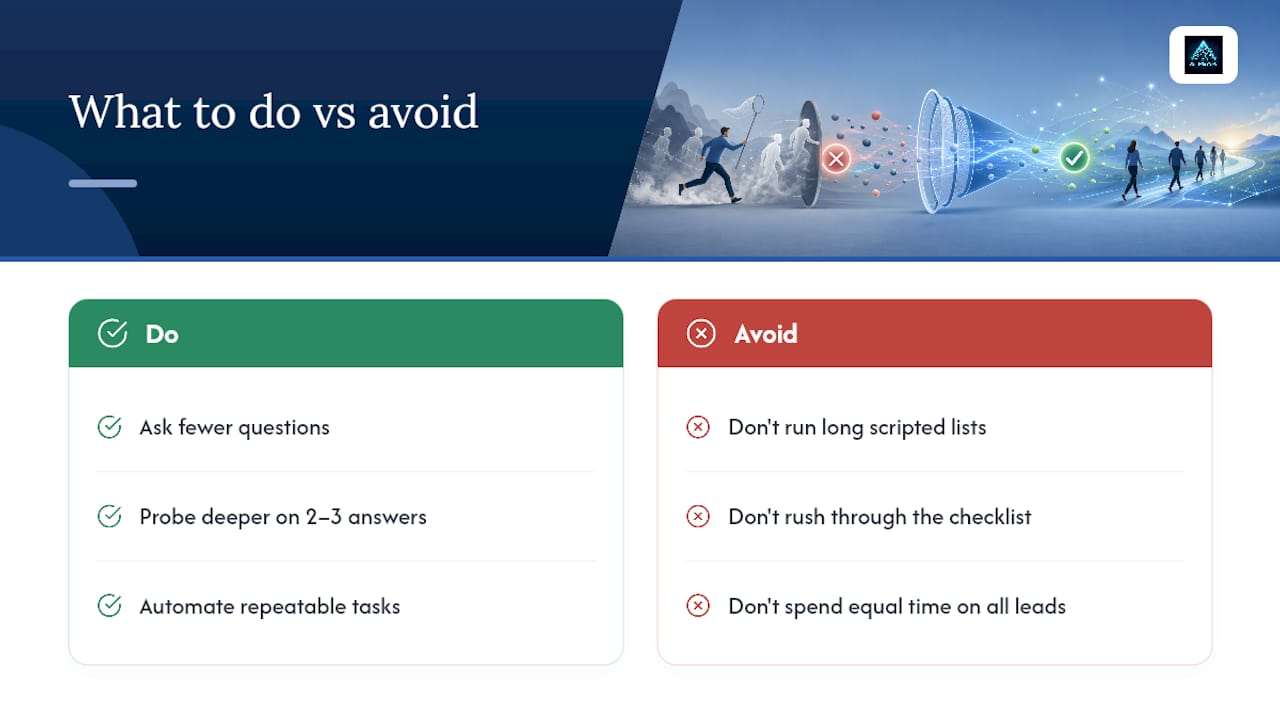
Picture a service business getting 40 inbound calls a week. Maybe 15 are genuinely qualified. If a rep spends equal time on all 40, the 15 good ones get diluted attention, and some slip through simply because nobody triaged them fast enough. The fix isn't a longer script. It's faster, sharper triage up front, so human attention goes where it earns the best return.
Try this next week: pick your three highest-leverage questions from this guide and run them, and only them, on your next ten inbound leads. Track what changes in your MQL-to-SQL rate. You'll likely find that three sharp questions, asked well, outperform a fifteen-question form that nobody reads closely.
How AI Peak Biz Helps You Qualify Leads Before You Even Pick Up the Phone
Every question in this guide assumes someone actually answers the phone or replies to the text fast enough to matter. That's the part most service businesses lose on before qualification even starts. AI Peak Biz is built for that gap: an AI voice agent (Ascent plan) can answer calls and book appointments by phone, day or night, before a lead has time to call your competitor instead.

The system captures qualification signals automatically, company size, the problem the caller describes, how urgent it sounds, and routes anything that clears your bar straight to a booked appointment on your calendar. Fewer calls sit in a voicemail queue overnight. If you want to see how AI-driven appointment setting handles this in practice, or how the same approach works for service businesses in your industry, start with a look at current plans and see which tier fits your call volume.
Sources
- Lead Qualification: The Definitive B2B Guide | Sendspark
- B2B Sales Qualification: 2026 Playbook for B2B Teams | SyncGTM