
By AI Peak Biz Team · August 29, 2026
Multichannel Messaging for Small Service Businesses

Centralize every channel into one inbox, automate lead capture and follow-up, and prioritize the two or three channels your customers actually use. That combination, more than any single app, is what separates businesses that book the lead and businesses that lose it to a competitor who replied first. AI Peak Biz builds exactly this kind of system for service businesses; the checklist and rollout steps below show you how to set it up yourself or vet a provider who can.
TL;DR:
- Prioritizing two to three customer-preferred channels for unified messaging significantly reduces lead response time and prevents losing prospects to competitors.
- Automated responses, instant answering, and integrated inboxes across SMS, web chat, and social messaging are critical for capturing and converting leads quickly.
- Choosing a platform with full automation, clear channel limits, and strong data privacy features ensures ongoing efficiency and compliance.
- Recovery sequences, quick follow-up, and personalized, segmented messaging within five minutes of inquiry dramatically increase conversion rates.
- Slow rollout, poor staff training, and neglecting channel-specific compliance can quickly undermine the benefits of a multi-channel messaging system.
Table of Contents
- What Is Multi-Channel Messaging for Small Business?
- Why Multichannel Messaging Matters for Small Businesses
- Which Channels Should a Small Business Actually Use?
- What Should You Look for in a Multi-Channel Messaging Platform?
- What Tactics Actually Drive Sales From Messaging?
- How Do You Roll Out a Messaging System Step by Step?
- How AI Peak Biz Puts This Checklist Into Practice
- How Do You Keep Messaging Data Private and Secure?
- How Do You Personalize Messages Across Every Channel?
- What Mistakes Do Small Businesses Make With Multi-Channel Messaging?
- When Should You Choose a Full Platform Over a Lightweight Tool?
- Ready to Stop Losing Leads to Slow Follow-Up?
- Sources
What Is Multi-Channel Messaging for Small Business?
Multi-channel messaging means running your customer conversations across several platforms, SMS, email, web chat, and social messaging, from a system that lets you manage them without opening five separate apps. A customer texts about an appointment, another messages your Facebook Business Page, a third fills out your website chat widget at 11 p.m. Multi-channel messaging is the practice of catching all three in one place.
It gets confused with omnichannel messaging, and the difference matters. Multi-channel just means you're present on several platforms. Omnichannel means those platforms are connected, so a conversation that starts on Instagram and continues over SMS reads as one continuous thread, not two disconnected ones. Most small businesses start multi-channel and grow into omnichannel as volume increases.
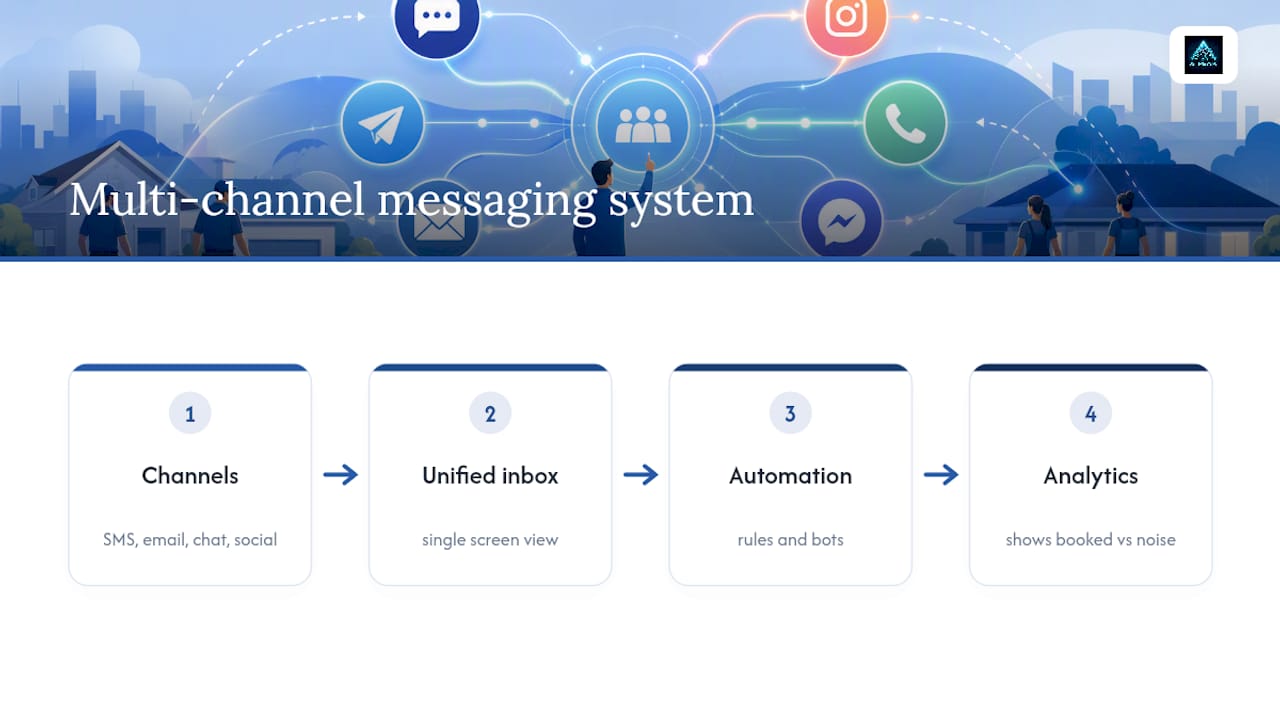
Four pieces make the system work. First, the channels themselves, wherever your customers already type. Second, a unified inbox for small business use that pulls every conversation into a single screen. Third, automation, the rules and bots that answer instantly and route messages to the right person. Fourth, analytics that tell you which channel actually produces booked appointments versus which one just generates noise. Skip any one of these four and the system leaks leads somewhere you won't notice until the revenue is gone.
Why Multichannel Messaging Matters for Small Businesses
Speed decides whether a lead becomes a customer or becomes a line item in a competitor's calendar. A missed call at 6 p.m. on a Friday doesn't wait for Monday. It gets sent to the next business on the search results page, and that business answers.
Multi channel communication tools shrink the gap between "customer has a need" and "customer gets a response" down to seconds instead of hours. That gap is where most small businesses bleed revenue without ever seeing it happen, because a lost lead doesn't file a complaint. It just goes quiet.
The clearest proof point is cart and inquiry abandonment. Global online cart abandonment rates run persistently high, and the same behavior shows up in service businesses as unbooked estimates and unanswered quote requests. A timely SMS or chat follow-up recovers a meaningful slice of those stalled conversations, often just by reminding the customer the option is still open.
Statistic Callout: Messenger apps rank among the most-used mobile apps worldwide, which tells you exactly where customer attention already lives. Building your response system around a phone that rings once and then rolls to voicemail ignores where the actual behavior is happening.
Retention follows the same logic. A customer who books through a two-way text thread, gets a reminder before the appointment, and receives a review request after the job is done experiences a business that feels attentive at every step. That consistency is what turns a one-time job into a repeat customer, and repeat customers cost far less to win than new ones.
Which Channels Should a Small Business Actually Use?
Not every channel deserves equal investment. Pick the ones your customers use and build real workflows around them, rather than spreading effort thin across every platform that exists.
- SMS: Best for appointment confirmations, reminders, and two-way booking changes. Response times are famously fast, and text messaging services built for small business let a customer confirm or reschedule with a single reply instead of a phone call.
- Web chat: Captures intent the moment someone lands on your site, before they bounce to a competitor's page. A chat widget that answers instantly converts browsing visitors into booked leads far more often than a "contact us" form that gets checked once a day.
- Facebook and Instagram direct messages: Social platforms are where a lot of local service inquiries start now, especially after someone sees a post or an ad. Treating those DMs as a real lead channel, not an afterthought, captures business that would otherwise sit unanswered.
- WhatsApp: Where it's supported and adopted by your customer base, WhatsApp allows richer messaging, images of a job site, PDF quotes, voice notes, and broadcast updates to a segmented list.
- Email and push notifications: Better suited to longer-form messages, receipts, and re-engagement campaigns than to first-contact response, but still valuable for nurturing leads who aren't ready to book yet.
A landscaping company might live and die by SMS and web chat. A boutique fitness studio might see most of its inquiries land in Instagram DMs. The right mix depends on where your customers already are, not on which channel looks impressive in a demo.
What Should You Look for in a Multi-Channel Messaging Platform?
Six criteria separate a platform that actually reduces your workload from one that just adds another login to manage.
- Unified inbox and threading. Conversations from every channel need to land in one workspace, with full history attached to each customer, not scattered across five apps you have to check separately. A unified inbox keeps a customer's SMS, chat, and email history visible in one thread instead of three.
- Automation and booking workflows. Look for AI chat handling and appointment-setting logic that can qualify a lead and get it on your calendar without a human touching every message.
- Official integrations and channel limits. WhatsApp Business API access and Meta-verified integrations matter because unofficial workarounds can get accounts suspended right when you need them most.
- Pricing model clarity. Some platforms charge per seat, others per message, others layer on API fees that only show up once you scale past a free tier. Ask for the full cost shape before you commit, not just the sticker price.
- Onboarding, support, and data ownership. Confirm who owns your contact list and conversation history if you ever switch providers, and ask what onboarding actually includes versus what costs extra.
- Reporting, SLAs, and escalation routing. You need visibility into response times and a clear path for messages that need a human to step in immediately.
Pro Tip: Before you sign anything, ask the sales rep to show you exactly how a missed call at 9 p.m. gets handled inside their system. If they can't demonstrate it live, assume it doesn't work the way the pitch deck claims.
AI Peak Biz's own approach to customer communication best practices leans hard on this checklist, because the businesses that skip even one item usually discover the gap the expensive way, mid-season, with leads already lost.
What Tactics Actually Drive Sales From Messaging?
Strategy separates the businesses that treat messaging as a mailbox from the ones that treat it as a sales engine. A few tactics consistently outperform the rest.
- Recovery sequences. A short SMS or chat message sent 30 to 60 minutes after an abandoned quote request, followed by a second touch the next day, recovers a real share of stalled inquiries. Multi-channel strategies built around chatbots and timed follow-up consistently outperform single-touch email reminders.
- Message-first ad journeys. Running ads that click directly into a Messenger or WhatsApp conversation, rather than a landing page, captures leads at the exact moment of interest instead of losing them to a slow page load.
- Two-way conversational booking. Letting a customer confirm, reschedule, or cancel an appointment by simply replying to a text removes friction that a phone tag cycle never solves.
- Segmented broadcasts. Sending a seasonal offer only to customers who opted in and match a relevant segment, say, past HVAC customers before summer, performs far better than a blast to your entire list, and it respects consent rules.
Timing carries as much weight as the message itself. A follow-up sent within five minutes of an inquiry converts at a dramatically higher rate than one sent the next morning, largely because the customer is often still comparing options in that window.
Statistic Callout: Businesses that pair chatbot automation with fast follow-up report meaningfully higher conversion from the same lead volume, simply because fewer inquiries go cold while waiting for a human to notice them.
Three numbers are worth tracking every week: time-to-first-response, conversion rate by channel, and revenue per contact. Time-to-first-response tells you whether your automation is actually catching leads before a competitor does. Conversion rate by channel tells you where to invest more effort. Revenue per contact tells you whether your messaging list is actually worth the time you spend maintaining it.
How Do You Roll Out a Messaging System Step by Step?
A realistic rollout takes three to five weeks for most small businesses, not the single afternoon a sales page might imply.
- Audit your current channels and contact lists (days 1 to 3). List every channel customers currently use to reach you, phone, SMS, social DMs, web forms, and note where response gaps already exist.
- Choose a platform and onboard channels (weeks 1 to 2). Connect your phone number, social accounts, and web chat widget into a single system built for cross-platform communication rather than juggling separate logins.
- Verify business accounts (timeline varies). WhatsApp Business API and Meta verification can take anywhere from a day to a couple of weeks depending on documentation and account history, so start this early.
- Build automations and templates, then train staff (weeks 1 to 2, overlapping with onboarding). Draft your confirmation, reminder, and follow-up templates, and walk your team through the escalation process for messages that need a human.
- Measure and iterate (ongoing). Review response times and conversion by channel monthly, and retire whatever channel isn't earning its place.
Cost has four real levers: seat or user fees, carrier and API costs tied to message volume, one-time onboarding or setup charges, and, if you go the managed route, an ongoing service fee. Ask any provider to itemize all four before you sign, because the seat price alone rarely tells the full story.
Slow rollout is often less costly than it looks. Businesses that rush this process without training staff on the new workflows tend to see contractor jobs slip through slow follow-up anyway, just through a different bottleneck.
How AI Peak Biz Puts This Checklist Into Practice
AI Peak Biz was built specifically around the gap that costs service businesses the most: the missed call and the slow follow-up that never happens. An AI voice agent can answer the call and book the appointment by phone in that same conversation, without waiting for a human to be free.
That covers most of the checklist directly. AI answering handles first response around the clock. Two-way SMS lets customers confirm or reschedule without a phone call. A unified inbox brings web chat, SMS, email, Facebook Messenger, Instagram, and Google Business Profile messages into one screen, so nothing gets missed because it landed on the "wrong" app. An AI appointment setter handles the booking logic itself.
In practice, this shows up as missed-call text-back that recovers a lead within seconds of a call going unanswered, same-day booking automation that turns an inbound text into a confirmed slot without a scheduling back-and-forth, and automated review requests sent after a job closes to build the reputation that wins the next customer.
Real-time communication is the deciding factor for service businesses that operate outside standard office hours, when a missed after-hours message often means a lost customer rather than a delayed one.
| What matters | How it shows up |
|---|---|
| Time-to-first-response | Instant AI answering on calls and texts, day or night |
| Unified inbox | SMS, email, web chat, Messenger, Instagram, Google Business Profile in one thread |
| Booking automation | AI appointment setter confirms slots without manual scheduling |
| Retention | Automated review requests sent after job completion |
How Do You Keep Messaging Data Private and Secure?
Multi-channel messaging means multiplying the places' customer data lives, which multiplies the places it can be mishandled. Each channel, SMS, WhatsApp, web chat, email, carries its own consent rules and its own risk if a conversation history gets exposed.
Start with consent. Customers need to know they're opting into SMS or WhatsApp marketing, not just transactional messages, and that opt-in needs to be documented, not assumed. Carrier rules around unsolicited text marketing carry real financial penalties, so treat consent tracking as a compliance function, not a formality.
Data ownership is the second issue small businesses overlook. If your platform vendor owns the conversation history and contact list rather than you, switching providers later means starting your customer relationships from zero. Ask this question before signing, not after a renewal notice arrives with a price hike attached.
Access control matters just as much internally. Not every employee needs to see every customer's full message history, especially in a small business where staff turnover is common. A platform that lets you limit who sees what, and logs who accessed a conversation, closes a real exposure gap.
Finally, confirm how long message data is retained and whether it's encrypted in transit and at rest. A vendor who can't answer that question clearly in the first conversation is not one to trust with your customer list.
How Do You Personalize Messages Across Every Channel?
Segmentation beats broadcasting every time, and the businesses that get this right treat their contact list as several smaller lists rather than one giant one. A customer who booked an HVAC tune-up last spring belongs in a different segment than someone who's never booked anything, and they should never get the identical message.
Use booking history as your primary segmentation lever. Past customers get renewal reminders and loyalty offers. First-time inquirers get a welcome sequence that builds trust before pitching anything. Customers who abandoned a quote request get a short, specific recovery message, not a generic newsletter.
Channel choice is itself a form of personalization. A customer who has only ever texted you probably doesn't want a phone call, and a customer who messaged through Instagram is signaling a preference for quick, informal replies over a long email. Matching your response channel to the one the customer initiated respects that signal, and personalizing the customer experience around those small cues tends to outperform generic scripts by a wide margin in practice.
Keep the personalization light and specific rather than elaborate. Using a customer's name and referencing their actual service history, "Your AC tune-up is due this month", beats a heavily templated message dressed up with merge fields. The goal is a message that reads like it came from a person who remembers the customer, not a system that just inserted a variable.
What Mistakes Do Small Businesses Make With Multi-Channel Messaging?
The most common failure is adding channels faster than staff can actually monitor them. A business that connects five platforms and then checks them once a day has built a system that looks comprehensive and performs worse than the single phone line it replaced.
Inconsistent tone across channels is a quieter problem. A customer who gets a warm, personal text and then a stiff, automated-sounding email from the same business notices the mismatch, and it erodes the trust the messaging system was supposed to build.
Ignoring compliance is the costliest mistake, because it's invisible right up until it isn't. Sending marketing texts without documented opt-in, or messaging a WhatsApp contact outside the platform's allowed windows, can get an account suspended at the exact moment it's generating the most leads.
Treating automation as "set it and forget it" undercuts the whole point. Templates go stale, seasonal offers keep firing after a promotion ends, and a chatbot that was accurate at launch drifts out of date as your services or pricing change. Review and update automations on a fixed schedule, monthly at minimum, rather than assuming they'll stay correct indefinitely.
Finally, businesses that adopt every channel their platform supports, rather than the two or three their actual customers use, waste setup time on channels that will sit empty. Match the tool to the customer's habits, not to the vendor's feature list.
When Should You Choose a Full Platform Over a Lightweight Tool?
A lean, single-channel tool works fine at low volume, a handful of leads a week and one or two channels. Once you're juggling three or more channels, need automated follow-up outside business hours, or have a limited budget for hiring a dedicated receptionist, a full platform earns its cost back quickly.
For most service businesses, the sensible rule is this: if a missed call or unanswered text costs you a real customer more than once a month, the lightweight setup is already too expensive. Run an honest audit of your current response gaps this week, then trial a platform built specifically for multi channel messaging for small business before your next slow season hits.
Ready to Stop Losing Leads to Slow Follow-Up?
Every strategy in this article depends on one thing actually happening: someone, or something, answering fast enough to catch the lead before it goes cold. AI Peak Biz built its entire platform around solving exactly that gap for local service businesses, HVAC, plumbing, roofing, landscaping, and similar trades, where a missed call after hours routinely turns into a booked job for a competitor instead.

Instead of stitching together separate apps for texting, chat, and social messages, AI Peak Biz gives you one system that answers fast and keeps your conversations in a single inbox. What that looks like in practice:
- Missed calls get answered and converted into text conversations automatically, day or night.
- Leads get qualified and booked through an AI appointment setter without a staff member touching every message.
- SMS, web chat, email, and social DMs all land in one unified inbox instead of five separate logins.
If you're ready to see how it handles your specific call volume and channel mix, check the AI chatbot page or compare pricing to find the plan that fits your business.
Sources
For a deeper look at the data behind the strategies covered here, Statista's tracking of global cart abandonment rates and its ranking of the most popular mobile messenger apps are worth bookmarking. Landbot's breakdown of multi-channel strategies that drive sales and SimpleTexting's comparison of business text services go further into channel-specific tactics. For a real-world example of consistent customer communication in a service setting, see this barbershop's approach to quality customer service.
- Statista, Online shopping cart abandonment rate worldwide
- Landbot, Top multi-channel messaging strategies to drive sales
- SimpleTexting, The 7 best text services for business, compared for 2026
- SendPulse, All customer messages in one inbox
Recommended
- Speed to Lead: Why Responding in 5 Minutes Wins the Job
- How Lead Response Time Affects Revenue
- Contractor Lead Follow-Up Mistakes