
By AI Peak Biz Team · September 7, 2026
Missed Call Text Back for Service Businesses
Enabling missed-call text back means every unanswered call triggers an instant SMS to the caller, opening a two-way text thread within seconds. For service businesses, that single feature recovers leads that would otherwise call your competitor next. Speed and two-way texting turn a missed ring into a real conversation, and often a booked job.
TL;DR:
- Speed is critical, because many replies come within the first few minutes, making rapid response essential to converting missed calls into booked jobs.
- Setting up requires verifying messaging permissions, building a trigger for unanswered calls, and routing responses to a shared inbox or CRM to ensure human follow-up.
- The most effective auto-texts stay under 160 characters, contain a clear call to action, and avoid multiple links or questions to maximize reply rates.
- Compliance involves registering sender IDs, including opt-out instructions, and maintaining transactional messaging focused on service rather than sales.
- Automated AI services can handle ongoing setup, monitoring, and qualification, significantly reducing manual effort and increasing response consistency.
Table of Contents
- How Does Missed Call Text Back Actually Work?
- Who Benefits Most From Text Back After a Missed Call?
- How Do You Set Up Missed Call Text Back?
- What Should Your Missed Call Text Actually Say?
- What Compliance Rules Apply to Automated Text Replies?
- What Metrics Prove Missed Call Text Back Is Working?
- How Do You Keep Missed Call Replies From Falling Through the Cracks?
- Why Speed Beats Perfection on This
- How Missed Call Text Back Services Handle This for You
- Sources
How Does Missed Call Text Back Actually Work?
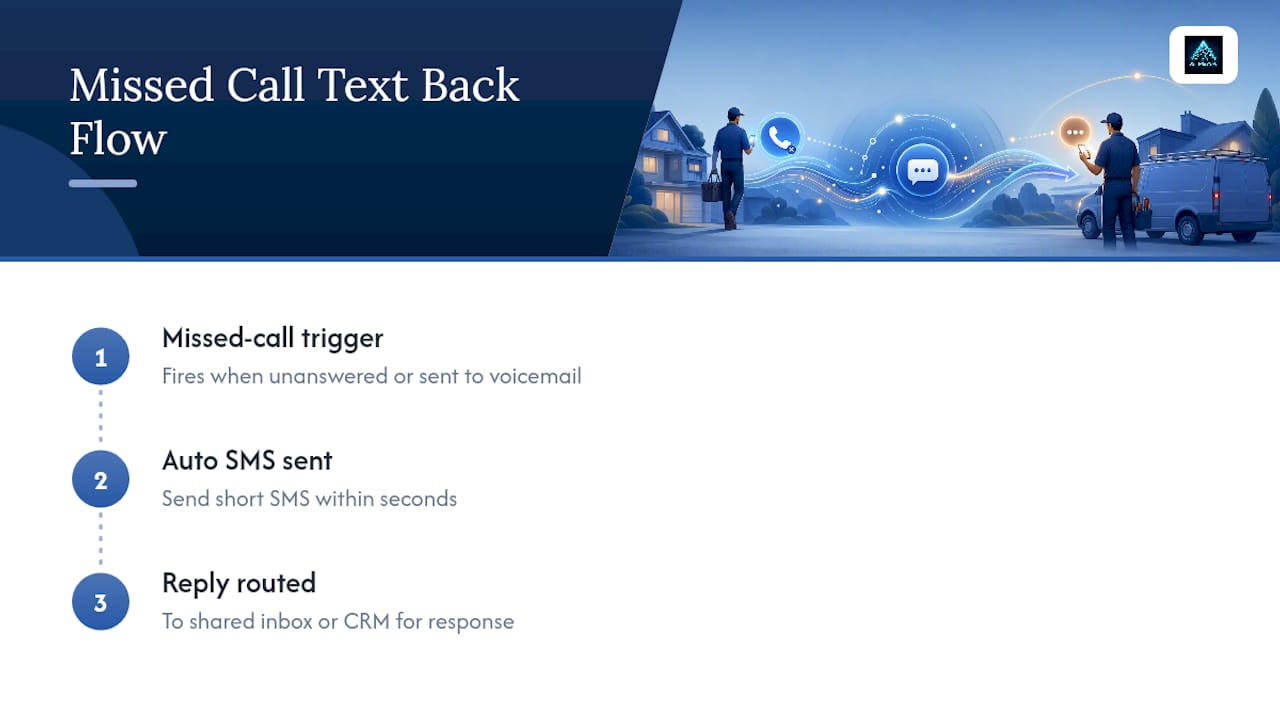
The mechanism is simple, but the pieces have to work together. A missed-call trigger fires the moment a call goes unanswered or lands in voicemail. That trigger lives either inside your phone platform's own workflow builder or in middleware that watches your call log and reacts to it.
Once triggered, the system sends a short SMS, ideally within seconds of the missed call, not minutes. That timing matters more than almost anything else in this process. A caller who just tried to reach you is still holding their phone, still thinking about the problem they need solved. Wait ten minutes and their attention has moved on.
The reply that comes back needs a home. Route it into a shared inbox or CRM where a real person can see it and respond, not into a single employee's personal phone. Miss the reply internally, and the automation's entire value disappears.
Who Benefits Most From Text Back After a Missed Call?
Any business that lives or dies by the phone benefits, but some feel it faster than others.
- Trades and home services (plumbing, HVAC, roofing, electrical): peak-hour calls flood in faster than a small crew can answer, and after-hours emergencies need triage, not silence.
- Medical and dental offices: missed appointment calls become booked visits instead of patients calling the next practice on their list.
- Salons and spas: last-minute cancellations open slots that a quick auto-text can refill same day.
- Restaurants and support teams: reservation and order questions get answered even during the dinner rush.
Across these groups, the pattern repeats: higher reply rates during busy periods, and a noticeable share of callers who never leave a voicemail but will happily respond to a text.
How Do You Set Up Missed Call Text Back?
Getting this running does not require an IT department, but it does require doing the steps in the right order.
- Secure your number. Either port your existing business line into a platform that supports text-back or provision a new number with texting enabled.
- Verify messaging permissions. Confirm the number is registered for business texting before you turn anything on.
- Build the trigger. Set the automation to fire on "no answer" or "voicemail" outcomes, and lock in a send delay measured in seconds, not minutes.
- Write and test your first message. Draft a short auto-text, send yourself a test call, and confirm the timing and wording both land right.
- Route replies properly. Point incoming responses to a shared inbox or CRM thread where someone is actually watching.
You have three real paths to get there. A platform with native workflow tools lets you build the trigger and message inside its own builder. A DIY stack using Zapier and Twilio gives you more flexibility if you already have development resources. Or you hand the whole thing to a managed AI front desk service that answers, texts, and books appointments without you touching a workflow builder at all.
Pro Tip: Test your auto-text by calling your own business line and letting it ring out. If the text takes longer than thirty seconds to arrive, your trigger delay is set wrong.
What Should Your Missed Call Text Actually Say?
The words matter almost as much as the timing. Templates that stay under 160 characters, name your business, and ask one clear question consistently outperform longer, salesy-sounding texts.
Try these as starting points:
- Booking: "Hi, this is [Business Name]. Sorry we missed you! What can we help you schedule?"
- After-hours: "Thanks for calling [Business Name]. We're closed right now, but reply here and we'll get back to you first thing."
- Urgent service: "This is [Business Name]. If this is an emergency, reply URGENT and we'll call you back immediately."
Keep the tone human and helpful, never robotic. Use the caller's name if your system captures it from caller ID or CRM data. Most importantly, give the message exactly one call to action, either a question or a single booking link.
Pro Tip: Never stack two links or two questions into one text. A caller facing multiple options often replies to neither, which is why one clean CTA consistently beats a crowded message.
What Compliance Rules Apply to Automated Text Replies?
Business texting in the U.S. runs through carrier-monitored channels, and skipping the paperwork gets your messages filtered or blocked before they ever reach a caller.
- Register your sender ID through the 10DLC process so carriers recognize your business texts as legitimate rather than flagging them as spam.
- Identify your business by name in the very first message, every time.
- Include STOP instructions in your initial text and honor opt-outs immediately, keeping a record of who asked to be removed.
- Keep the first text strictly transactional. A missed-call reply is not the place for a sale or a promotion.
- If you operate in healthcare or another regulated field, build in extra care around what personal information the auto-text can reference.
Getting these basics right protects your deliverability and keeps you clear of avoidable complaints.
What Metrics Prove Missed Call Text Back Is Working?
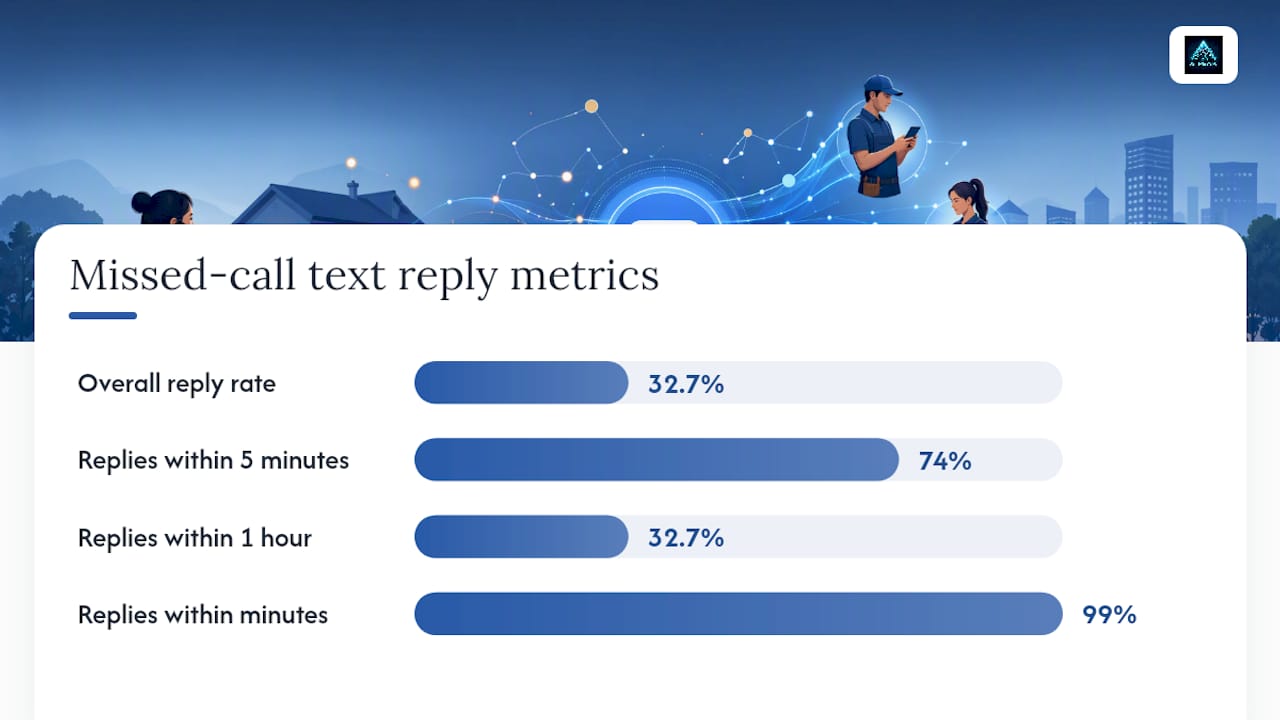
Track five numbers monthly: missed-call volume, auto-texts sent, reply rate, time to first human response, and the share of replies that convert into booked work. Watch opt-outs too, since a rising number there usually signals your messaging or frequency needs adjusting.
A 2026 study of 14,354 automated missed-call texts sent by home service businesses found a 32.7% overall reply rate, with 74% of those replies landing within five minutes. Of the replies received, 1,619 turned into billable leads.
| Metric | Benchmark |
|---|---|
| Overall reply rate | 32.7% |
| Replies within 5 minutes | 74% |
| Replies within 1 hour | 32.7% |
| Replies within minutes | 99% |
The takeaway: nearly three-quarters of the people who reply do it within five minutes of getting your text, which means your team's response window has to be just as fast, or you lose the advantage the auto-text just bought you.
Run your own numbers against a missed-call revenue calculator to see what a 30% reply rate is actually worth in booked jobs at your average ticket price. Pairing that first text with a broader lead-nurturing strategy keeps callers engaged even if they don't book on the first exchange.
How Do You Keep Missed Call Replies From Falling Through the Cracks?
The automation is the easy part. The operational discipline around it is what determines whether it actually pays off.
Assign clear ownership of the shared inbox, whether that's a front-desk employee, an office manager, or a rotating on-call staffer. Set a service-level target, ideally under five minutes during business hours, for the first human reply once a lead responds. Never let every team member see the same inbox with no assigned owner; that setup tends to get messages answered twice or not at all.
Some businesses reach a volume where a human can no longer keep pace with the reply flow, especially during after-hours windows. That's the point where an automated call follow-up system or a managed AI front desk starts to make more sense than adding another staff member. Either way, review your reply rates monthly, adjust your message copy, and re-route ownership as call volume grows.
Why Speed Beats Perfection on This
Contractors and service business owners lose more revenue to slow follow-up than to bad marketing, and most don't realize it until they actually count the missed calls in a given week. The businesses that get this right treat the first text less like a marketing message and more like picking up the phone, just a few seconds later than they'd prefer.
What surprises people most is how little the message itself matters compared to the timing. A perfectly worded text sent eight minutes late loses to a plain, slightly clumsy text sent in five seconds. AI Peak Biz built its missed-call text-back service around that exact principle: answer and text fast, then let a human take over the conversation once it's warm.
How Missed Call Text Back Services Handle This for You
If you've read this far, you already know the setup checklist works, but it also takes ongoing attention: monitoring reply rates, tweaking templates, keeping compliance current. Some services remove that maintenance entirely by running the whole process for you. Their AI system answers the call itself, sends the text within seconds if no one picks up, qualifies the lead through natural back-and-forth conversation, and books the appointment directly on your calendar, all without you touching a workflow builder or checking a shared inbox yourself.
That's the real advantage over building a DIY Zapier-and-Twilio stack or relying on a platform's native automation alone: nothing depends on you remembering to test it, update the message, or watch the reply queue. The AI appointment setter handles qualification and scheduling in the same conversation the text-back starts, and it runs whether you're on a job site, asleep, or slammed with other calls.
See what it would recover for your business specifically using the missed-call revenue calculator, or check pricing and book a walkthrough to see the system answer a test call live.
Sources
- Does Missed Call Text Back Actually Work?, 99 Calls
- The Complete Guide to Missed-Call Text Back | WorkflowStack AI
Recommended
- Missed Call Revenue Calculator, How Much Are You Losing?
- Missed Call Text-Back for Contractors: How It Works and Why You Need It
- Missed Call Text-Back for Service Businesses
- The Real Cost of Missed Calls for Contractors