
By AI Peak Biz Team · September 25, 2026
Prevent Suspension and Fines: Google Review Gating for Business Owners

Google review gating is prohibited under Google's own content policy and can expose your business to civil penalties under the FTC's final rule on fake and manipulated reviews. The immediate risks are review removal and Google Business Profile suspension, plus federal liability if the gating is deliberate. The safer path is a systematic, even-handed review request process that invites every customer, not just your happiest ones.
TL;DR:
- Review gating involves selectively inviting only satisfied customers to leave public reviews, which violates Google's policies and can lead to review removal or profile suspension.
- Artificially filtering or delaying review requests based on customer satisfaction scores violates both Google's and FTC's rules, risking civil penalties for deliberate manipulation.
- Businesses should send neutral, identical review requests to all customers and avoid any survey logic or outreach that links review invitations to internal satisfaction ratings.
- Proper compliance requires auditing review platforms for sentiment-based filtering features and documenting the neutral review solicitation process.
- Automating a consistent, fair review request system that treats all customers equally prevents accidental violations and aligns with legal and platform guidelines.
Table of Contents
- What Is Review Gating, Exactly?
- What Does Google's Policy Actually Say?
- What Does the FTC's Rule Mean for Gating?
- How Do You Avoid Review Gating?
- How Do You Report Suspected Review Gating?
- Why Even-Handed Review Requests Beat Gating Every Time
- A Compliant Way to Automate Review Requests
- Key Policies Worth Bookmarking
- Sources
What Is Review Gating, Exactly?
Review gating means filtering which customers get invited to leave a public review based on how satisfied they seem to be. A general review request, sent to every customer who used your service, is not gating. Routing only your happy customers toward Google while quietly redirecting unhappy ones elsewhere is.
Here's what it typically looks like in practice:
- A post-service survey asks "How was your experience?" and only shows the public Google review link to customers who click 4 or 5 stars.
- Front-desk staff are instructed to "ask the regulars who love us" for reviews, while skipping anyone who complained.
- A feedback widget captures negative comments internally and never surfaces a public review option to that customer at all.
- An automated text campaign only fires the review request after a separate satisfaction score clears a threshold.
There's a legitimate gray zone worth understanding. Private service recovery, a manager calling an unhappy customer to fix a problem before ever mentioning reviews, is fine on its own. It becomes gating the moment you use that private outreach to decide who gets invited to review you publicly and who doesn't.
What Does Google's Policy Actually Say?
Google's Maps User Contributed Content Policy is direct about what counts as manipulation. It doesn't leave much room for interpretation:
That single clause from the Maps content policy covers most gating tactics in one sentence: selective solicitation, review-for-payment schemes, and pressure to suppress criticism.
Enforcement follows a predictable escalation. Google typically removes the flagged reviews first, then applies ranking penalties to the listing, and in repeat or severe cases suspends or terminates the Business Profile entirely. Google's systems are also built to flag patterns, not just individual complaints. Watch for these red flags on your own profile:
- A sudden spike in five-star reviews within a short window
- Reviews mentioning incentives, discounts, or "thanks for the free service"
- Multiple reviews from accounts with no other review history
- Staff or owners posting reviews for their own business
What Does the FTC's Rule Mean for Gating?
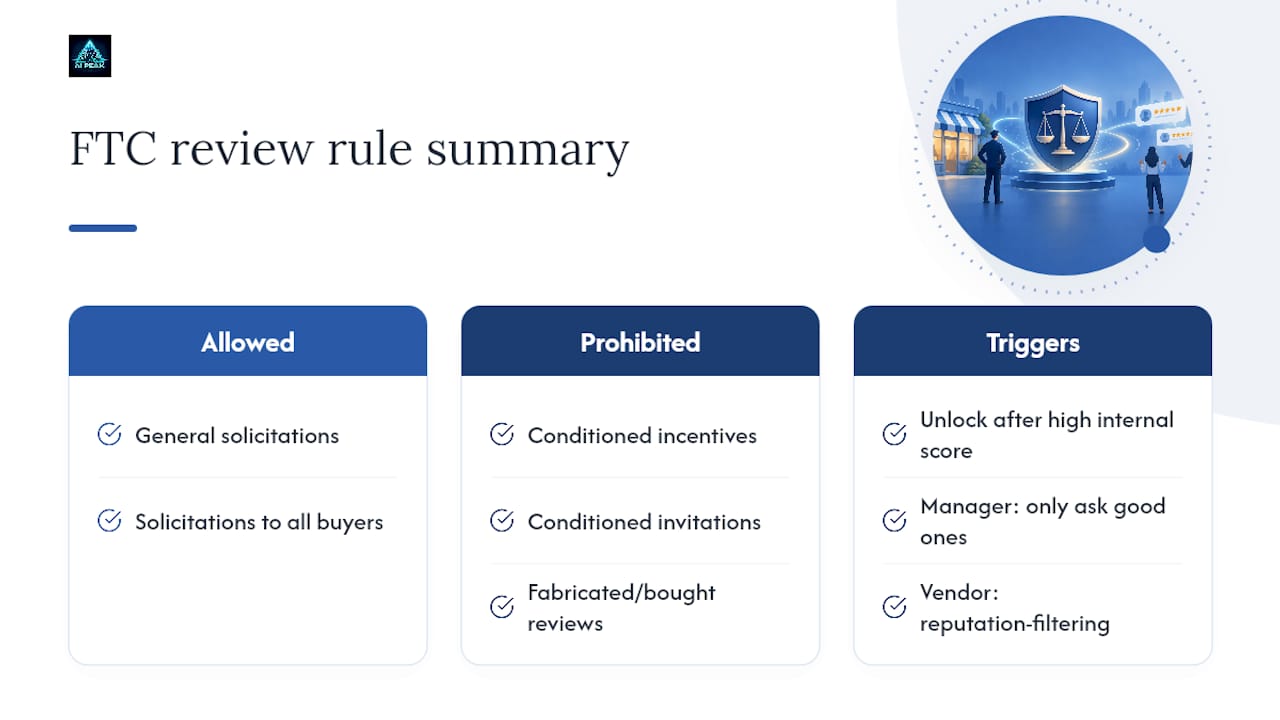
The FTC's final rule on consumer reviews and testimonials, which took effect October 21, 2024, made review manipulation a federal matter, not just a platform-policy issue. The rule bans review suppression, prohibits incentives conditioned on a particular rating or sentiment, and targets fabricated or bought reviews.
The FTC's own Q&A on the rule draws a useful line: generalized solicitations sent to all purchasers are allowed. What's not allowed is conditioning the incentive, or the invitation itself, on the reviewer promising or delivering a specific sentiment.
The rule authorizes civil penalties for "knowing" violations. That standard matters. A business that builds a survey funnel explicitly designed to filter out unhappy customers before they reach a public review link has a hard time arguing it didn't know what the tool was doing.
Real-world triggers include a review platform that only unlocks the Google review button after a high internal score, a manager telling staff to "only ask the good ones," or a vendor contract that markets "reputation filtering" as a feature. Each of those creates a paper trail regulators can point to.
How Do You Avoid Review Gating?
Compliance isn't about asking for fewer reviews; instead, following a step-by-step guide for SMBs on how to manage online reputation can help ensure that your review process is fair and effective. It's about asking the same way, every time, for every customer.
- Invite everyone. Send the same review request to every customer who completed a service, using neutral language like "We'd love your feedback on Google" rather than anything tied to satisfaction level.
- Audit your vendor's logic. Many reputation platforms include a "sentiment routing" feature by default. If your survey tool only reveals the public review link after a preliminary rating, that configuration itself is the gating mechanism and needs to be disabled.
- Separate service recovery from review requests. Handle complaints privately through a support ticket or a direct call, but don't let the outcome of that conversation determine whether the customer gets a public review invite.
- Time it consistently. Send requests on a fixed schedule after service completion, not based on how the interaction went.
- Keep records. Log who was contacted, when, and with what message, so you can demonstrate a neutral process if a platform or regulator ever asks.
Pro Tip: Ask your review software vendor directly whether any feature filters, delays, or conditionally displays the public review link based on a rating. If they can't answer clearly, assume it does and turn it off.
A 7-step SMS review request system built around one consistent message to every customer removes the temptation to gate almost entirely, because there's no branching logic left to configure.
How Do You Report Suspected Review Gating?
If you spot a competitor or vendor running a gated flow, or your own reviews get flagged by mistake, evidence is everything. Screenshot the survey or request flow, including any branching logic, and note timestamps.
- Capture the exact wording of the solicitation message and any conditional steps.
- Pull vendor logs if you manage a third-party review tool that shows how invitations were routed.
- Submit a report through Google Business Profile support, referencing the specific policy language it violates.
- If your own profile is flagged incorrectly, document your neutral solicitation process and file an appeal with those logs attached.
- Keep monitoring your review velocity and sentiment mix monthly. A pattern that looks off to you will look off to Google's systems too.
Community threads on the Google Business Profile help forum show how these reports and Google's responses typically play out, which is worth reading before you file your own.
Why Even-Handed Review Requests Beat Gating Every Time
I've looked closely at how the FTC rule and Google's policy interact, and the pattern is consistent: enforcement targets the mechanism, not the intent behind it. A business that means well but automates selective solicitation is still exposed. The fix isn't caution, it's better process design. An automated system that treats every customer the same way, happy or not, is both compliant and honestly a better signal of your real reputation. I'd encourage any owner reading this to pull up their current review workflow today and check exactly where the branching happens.
A Compliant Way to Automate Review Requests
Building an even-handed review process by hand, tracking who got asked, when, and how, is tedious enough that most businesses eventually cut corners without meaning to. The client's review-request automation sends the same solicitation to every customer through a consistent, sentiment-agnostic workflow, so there's no branching logic left to accidentally violate Google's policy or the FTC rule.
The system runs on the same unified inbox used for missed-call text-back and lead follow-up, meaning your review requests, customer replies, and service recovery conversations live in one place instead of scattered across a survey tool, a CRM, and a spreadsheet. That makes an honest audit trail, exactly what the FTC guidance recommends, something you get automatically rather than something you have to build. If you want the specifics on how the request sequence works, the 7-step SMS review request breakdown walks through the timing and messaging. Plans start with AI Website, with Base Camp, Ascent, and Summit plans also available for businesses that want the full automation suite. Current subscription prices are available on the pricing page. Visit AI Peak Biz to see which plan fits your review volume and get your review request workflow running this week.
Key Policies Worth Bookmarking
Before you change anything in your review process, read the source documents yourself. Google's and the FTC's own language is clearer than most summaries of it, including this one.
- Google Maps User Contributed Content Policy: the full list of prohibited and restricted review practices.
- FTC final rule press release and FTC Q&A on the rule: effective dates, penalties, and what's actually prohibited.
- Google Business Profile community thread: a documented, real-world gating example and Google's response.
This article is general information, not a substitute for advice from a qualified lawyer. Consult a qualified legal professional about your own circumstances before acting on anything here.
Sources
- Prohibited & restricted content - Maps User Generated Content Policy Help
- Federal Trade Commission Announces Final Rule Banning Fake Reviews and Testimonials | Federal Trade Commission
- The Consumer Reviews and Testimonials Rule: Questions and Answers | Federal Trade Commission
- Review gating example - Google Business Profile Community
Recommended
- Get More Google Reviews: A 7 Step System for Small Businesses
- AI Reputation Management for Contractors: Get More 5-Star Reviews on Autopilot
- 7 Steps to SMS First Review Request Automation for Local Service SMBs
- Reputation Management for Service Businesses
FAQ
Is Review Gating Illegal?
Review gating violates Google's content policy outright, which can get reviews removed or your profile suspended. It can also violate the FTC's final rule if the gating involves review suppression or incentives conditioned on sentiment, which opens the door to civil penalties for knowing violations.
How Do I Avoid Review Gating?
Send the same review request to every customer, regardless of how the service went, and keep the wording neutral. Audit any review software you use for sentiment-based routing, since many platforms hide the public review link by default based on an internal rating, and disable that feature if it's present.
What Is a Gated Review?
A gated review is one that only reaches the public because a customer passed an internal filter, usually a survey question or star rating, before ever seeing the invitation. Customers who might leave a negative review never get asked at all, which creates a skewed, artificially positive profile.
What Is the Google 20% Rule?
There isn't an official Google rule by that name in Google's published policy. If you've seen it referenced, it's likely an informal industry term some vendors use, and it's not something Google's Maps content policy defines, so treat any specific percentage claim tied to it with caution.