
By AI Peak Biz Team · September 23, 2026
Launch Med Spa Patient Texting in 30 to 90 Days

Yes, med spas can text patients, but only if three things are true: you have express consent that matches the message type, you keep protected health information out of the text body, and you have a signed Business Associate Agreement with any vendor that touches patient data. If any of those three is missing right now, pause promotional texting until you fix it and pull your vendor contracts to check for a BAA.
TL;DR:
- Sending promotional texts without explicit consent or a signed Business Associate Agreement risks violations that can incur thousands in fines per message.
- Texts referencing specific treatments, diagnoses, or clinical photos are considered protected health information, requiring secure delivery methods or generic phrasing.
- Proper documentation includes recording consent at the time of opt-in, storing details, and processing opt-outs immediately with automated confirmation.
- The safest and most effective workflows focus on appointment confirmations, rebooking, and follow-ups, which carry minimal legal risk and generate high value.
- Confirm your texting setup and consent process with your own compliance advisor before you text patients.
Table of Contents
- Med Spa Patient Texting and the Law: TCPA, FCC, and State Risk
- What Counts as PHI in a Text, and How to Word Messages Safely
- Documenting Consent and Handling Opt-Outs the Right Way
- High-Value SMS Workflows to Build First
- Choosing a Texting Platform Built for Med Spas
- Your 30 to 90 Day Texting Rollout Plan
- Why State Law Can Change Your Risk Overnight
- The Compliance Mindset That Actually Protects Revenue
- A Faster Way to Answer Texts and Calls
- Sources
Med Spa Patient Texting and the Law: TCPA, FCC, and State Risk
The Telephone Consumer Protection Act treats your texts differently depending on what they say. Appointment reminders, rebooking nudges, and post-care check-ins generally count as transactional or informational messages, which require only that the patient gave you their phone number in a context connected to the service. Marketing texts, like a promotion for a new filler package or a seasonal discount, need prior express written consent, meaning a signature or an equivalent digital opt-in that specifically names texting as the channel.
That single message can turn a compliant reminder program into a TCPA violation, because the consent on file never covered marketing.
The FCC's enforcement guidance shows the agency actively pursuing unsolicited and non-consented messaging, with per-message statutory damages that can climb into the thousands when a campaign reaches a full patient list. A batch send to 500 patients without proper consent is not a rounding error. It is 500 potential violations.
State law adds another layer on top of the federal floor. Some states impose registration requirements, bonding, or broader definitions of "solicitation" that federal law does not touch, and Wipfli's analysis of TCPA rules makes clear that informational and marketing consent cannot be treated as interchangeable, even when they come from the same patient.
The safest operating rule for a med spa: default every promotional or discount message to the express written consent standard, even in states where the federal bar is technically lower. Practically, that means:
- Never send pricing promotions to a list built only from appointment bookings.
- Keep a separate opt-in checkbox specifically for marketing texts, worded to name texting by name.
- Treat any text mentioning a discount, package, or new service launch as marketing, full stop.
What Counts as PHI in a Text, and How to Word Messages Safely
A text becomes protected health information the moment it references a specific treatment, diagnosis, billing detail, or clinical photo tied to an identifiable patient. "Your appointment is confirmed for Tuesday at 2pm" is safe. "Your Botox follow-up for the forehead lines is confirmed for Tuesday" edges into PHI territory, because it names a treatment area tied to a named patient's care.
HHS guidance on electronic communication confirms that HIPAA does not ban texting outright, but it does require "appropriate safeguards" once a message carries PHI, and standard SMS was never built with those safeguards in mind. Plain SMS has no encryption at rest, no access controls, and no audit trail beyond whatever your carrier or platform happens to log.
The American Med Spa Association's guidance on health care communication recommends keeping message bodies generic and moving anything clinical to a secure channel, such as a patient portal. Confirm your texting setup and consent process with your own compliance advisor.
Safe phrasing looks like this:
- "You have an appointment on [date] at [time]. Reply C to confirm or R to reschedule."
- "It's been 3 weeks since your last visit. Ready to book your follow-up? Reply YES."
- "Your provider has a note for you. Please check your patient portal or call us."
Avoid naming treatments, dosages, before-and-after photos, or anything a stranger glancing at the phone could tie to a medical condition.
Pro Tip: Designate SMS as your scheduling and convenience channel, not your clinical channel. The moment a reply mentions swelling, bruising, or a reaction, move that conversation to a secure portal or a phone call, and log that you made the switch.
A BAA becomes necessary the moment your texting platform stores, transmits, or has access to PHI, even if PHI rarely appears in outgoing messages. If a patient replies with a symptom description, that reply lives on the vendor's servers, and an unprotected vendor just became a liability.
Documenting Consent and Handling Opt-Outs the Right Way
Verbal permission at check-in is not documentation. If a state investigator or a plaintiff's attorney asks you to prove a patient consented to texting, "we always ask at the front desk" will not hold up. You need a record.
- Capture consent at the source. Add a checkbox to intake forms, your booking widget, and any web form, worded separately for appointment texts versus marketing texts.
- Store four fields for every opt-in: patient name, phone number, date and time of consent, and the exact method used (paper form, web checkbox, keyword text like "JOIN").
- Save the exact language shown to the patient at the moment of consent. Wording changes over time, and you need to know what version a given patient agreed to.
- Process STOP replies immediately and automatically. Every message should support "Reply STOP to opt out," and your platform should suppress that number from future sends within minutes, not days.
- Send an auto-confirmation on opt-out ("You've been unsubscribed and won't receive further texts") so the patient has proof the request went through.
- Retain consent and opt-out records for at least the length of your state's statute of limitations on relevant claims, which in most cases means keeping them well beyond a single patient relationship.
That paper trail is what protects you when someone disputes a message months later. Without it, you are relying on memory against a timestamped complaint.
High-Value SMS Workflows to Build First
The workflows worth building first are the ones with the lowest legal exposure and the highest financial return, which is a better combination than most med spas assume exists. Textline's data on med spa texting points to appointment reminders, rebooking cadences, and cancellation-fill messages as the strongest use cases, and all three sit comfortably inside the transactional consent standard when phrased correctly.
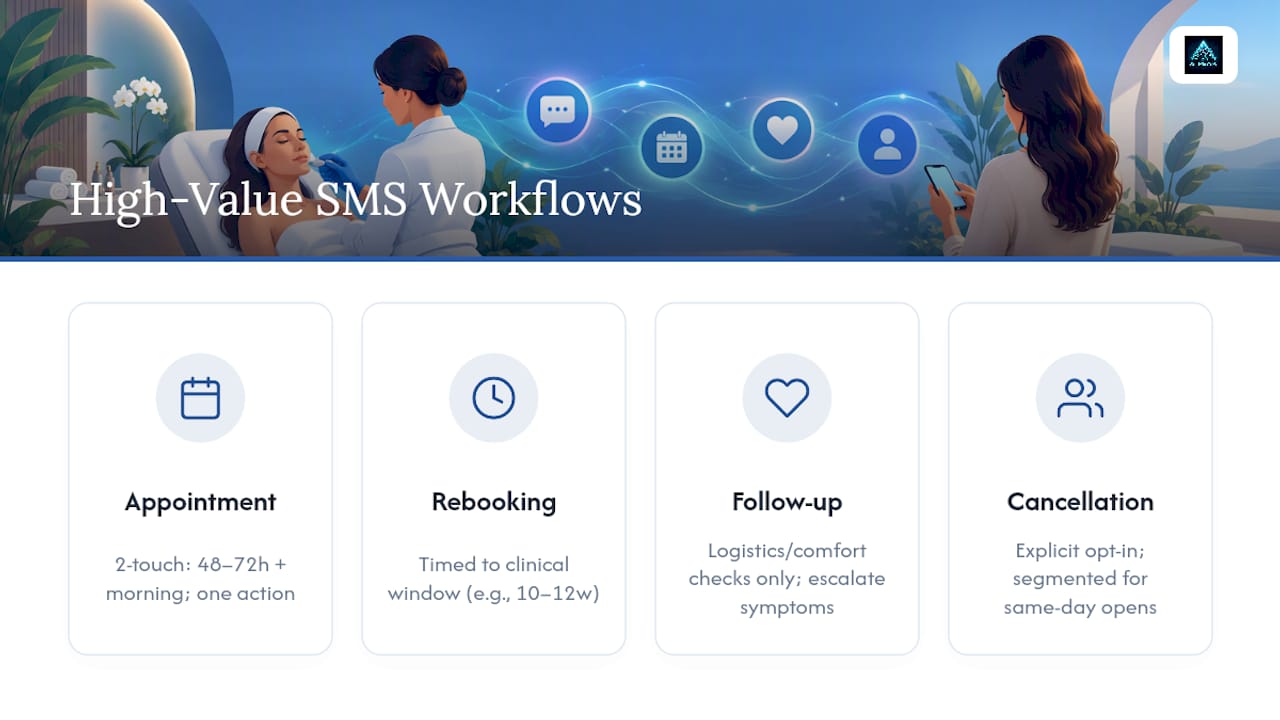
Appointment reminders work best on a two-touch cadence: one message 48 to 72 hours out, a second one the morning of the appointment, each with a single clear action. "Reply C to confirm or R to reschedule" beats a paragraph explaining your cancellation policy. One instruction, one reply option.
Treatment-cadence rebooking targets the natural rhythm of the service itself. A neurotoxin patient at the 10 to 12 week mark, a chemical peel patient at the 4 week mark. Time the message to the clinical window, not an arbitrary marketing calendar, and phrase it around timing rather than treatment specifics: "It's been about 3 months since your last visit. Want to grab a spot this week?"
Post-visit follow-up should stick to logistics and comfort checks, never diagnosis. "How are you feeling after yesterday's visit?" is fine. Anything more specific belongs behind a secure portal login, and staff should be trained to move a reply that mentions a symptom into that secure channel immediately, with the escalation logged.
Cancellation fills deserve their own segmented list of patients who have opted in specifically to same-day or short-notice openings. That segmentation matters twice over: it respects consent boundaries and it targets people who actually want last-minute slots, rather than blasting your entire database every time someone cancels.
Pro Tip: Build your cancellation-fill list as an explicit opt-in, separate from general reminders. Patients who join it are telling you they want short-notice texts, which makes your open and response rates far stronger than a blanket send.
Automating these workflows through a system built for SMS appointment reminders removes the manual guesswork of when to send and what to say.
Choosing a Texting Platform Built for Med Spas
Not every SMS tool is built to sit near patient data, and the gap between a consumer texting app and a clinic-grade platform shows up fast once you look for it. Before signing a contract, confirm the vendor will sign a BAA covering the specific services you plan to use, not a generic agreement that excludes text logging or attachment storage.
Look for:
- A signed BAA that names texting explicitly, not just email or portal messaging.
- Encryption in transit and at rest, plus role-based access so front desk staff cannot see billing notes and providers cannot see marketing lists.
- Audit logs that timestamp every message sent, received, and deleted.
- Native STOP processing that suppresses a number platform-wide, not just within one campaign.
- Local-time scheduling so a reminder never lands at 6 a.m. because a patient traveled to a different time zone.
- List segmentation to separate marketing consent from transactional consent cleanly.
- EHR or booking system integration so consent status and appointment data stay synced, rather than living in two disconnected tools.
A partner resource worth reviewing on the security side is this overview of healthcare communication solutions, which walks through the infrastructure questions most vendor sales calls gloss over.
Red flag: any vendor that hesitates on the BAA question or tells you "texting doesn't really count as PHI." That is precisely the assumption that gets practices fined.
Your 30 to 90 Day Texting Rollout Plan
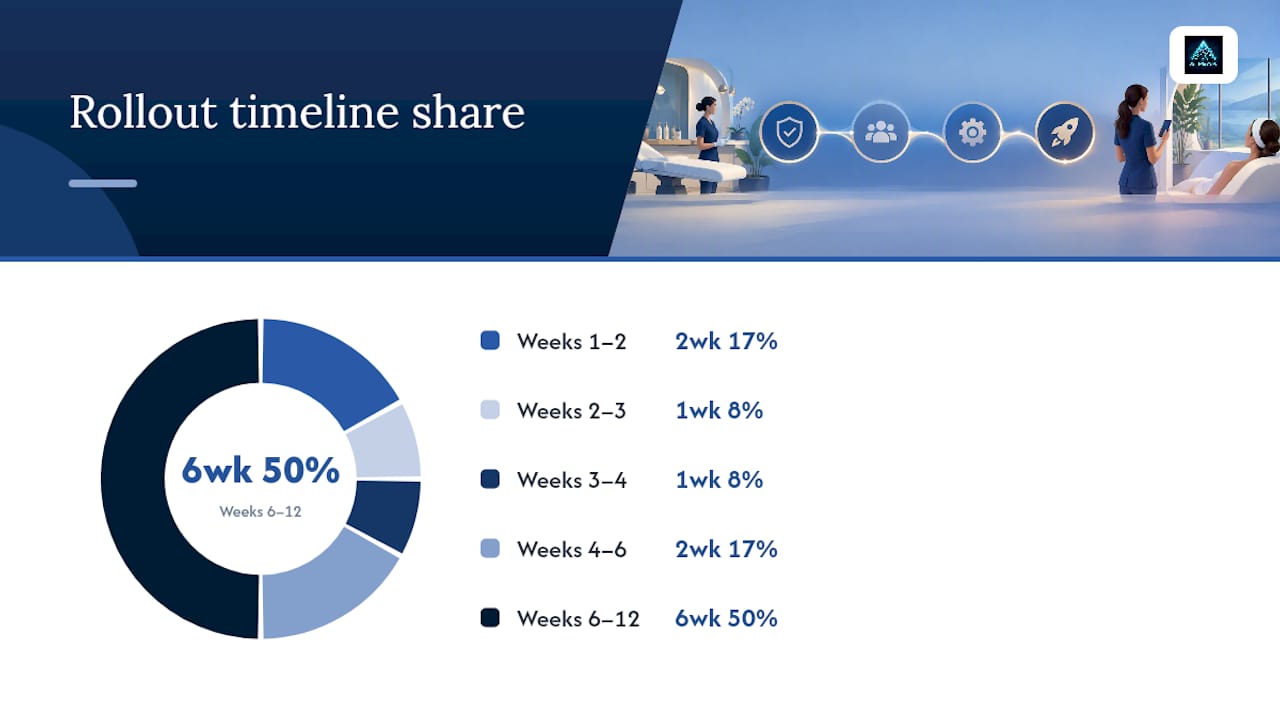
- Weeks 1 to 2: Rewrite intake forms and web booking pages with separate consent checkboxes for transactional texts and marketing texts, worded to name SMS specifically.
- Weeks 2 to 3: Segment your existing patient list into transactional-only, marketing-opted-in, and cancellation-fill groups based on the consent you can actually document today.
- Weeks 3 to 4: Configure your platform's BAA, STOP handling, quiet hours, and frequency caps so no patient gets more than a reasonable number of texts per week.
- Weeks 4 to 6: Train front desk and clinical staff on which phrases are safe, which get escalated to a secure portal, and how to log every escalation.
- Weeks 6 to 12: Launch reminders and rebooking cadences first, monitor opt-out rates and response times weekly, and hold marketing campaigns until the segmented list is clean.
Pro Tip: Track your opt-out rate as a compliance signal, not just a marketing metric. A sudden spike usually means a message crossed from transactional into promotional territory without the right consent behind it.
Set concrete KPIs from day one, such as opt-out rate, response time during business hours, and no-show rate, and track them monthly against your pre-launch baseline. Those numbers tell you whether the program is working and whether it is staying inside its consent boundaries.
Why State Law Can Change Your Risk Overnight
Federal rules set the floor, not the ceiling. A growing number of states layer stricter marketing definitions, registration requirements, or bonding rules on top of the TCPA, and a 2025 analysis of Texas's text message law shows how a state can redefine "solicitation" broadly enough to catch messages that would pass federal scrutiny without issue.
If your patient list spans multiple states, or you run seasonal promotions to patients who traveled from out of state for a procedure, the safest move is to segment campaigns by patient location and apply the strictest applicable state rule to that segment.
- Treat any new state-specific SMS statute as a trigger to review your marketing consent language before your next campaign.
- Pause a promotional send pending legal review whenever a state's rules are unclear or newly changed.
- Never assume a compliance approach that works in one state automatically transfers to another.
The Compliance Mindset That Actually Protects Revenue
Most of the fear around med spa patient texting comes from treating every message like a marketing message. It is not. The highest-value, lowest-risk texts a med spa sends are the boring ones: confirmations, reminders, rebooking nudges timed to a treatment cycle. Those carry minimal legal exposure and drive the bulk of the financial return, since most Americans already screen calls from unknown numbers and rely on text as the channel that actually gets read.
The mistake I see most often is a spa either avoiding texting entirely out of fear, or texting everything without segmentation and hoping nobody complains. Both extremes cost money. A missed call that never gets a callback is a lost booking; a promotional blast sent without proper consent is a legal exposure with a per-message price tag. Automated response systems can help with both problems. They reply fast while you keep message content generic. Confirm your texting setup and consent process with your own compliance advisor.
A Faster Way to Answer Texts and Calls
Most med spas lose bookings not because of bad marketing, but because a call rings out or a text sits unread for hours while staff are mid-treatment. Some platforms are designed to help close that gap: an AI voice agent can answer calls and book appointments by phone, and missed-call text back can reply within moments, so fewer missed calls become lost patients.

The platform's missed-call text-back feature fires the moment a call goes unanswered, turning a silent voicemail into an immediate conversation. For med spas specifically, the AI front desk built for med spa workflows handles reminders, rebooking prompts, and a unified inbox across text, chat, and social messages, with hands-on onboarding to help you set consent language and message cadence correctly from day one rather than guessing.
If you are ready to see how automated response and texting workflows fit your practice, review the Ascent or Summit plans and ask about an implementation checklist during your demo. Confirm your texting setup, BAA needs, and consent process with your own compliance advisor.
This article is general information, not a substitute for advice from a qualified doctor. Consult a qualified healthcare professional about your own circumstances before acting on anything here.
Sources
- HHS, Does HIPAA permit health care providers to use email to discuss health issues with patients? (FAQ)
- FCC document, enforcement actions and guidance relating to automated and unsolicited messaging
- American Med Spa Association, Best practices in health care communication
Recommended
- Cut No Shows Fast: Three Message SMS Reminders for Small Businesses
- AI Front Desk for Med Spas
FAQ
Is It a HIPAA Violation to Text a Patient?
Not automatically. Texting a patient becomes a HIPAA problem only when the message contains protected health information sent through a channel without appropriate safeguards, so a generic appointment confirmation carries far less risk than a text naming a specific treatment or attaching a clinical photo, per HHS guidance.
Do Med Spas Need to Follow HIPAA?
Yes, if the med spa is a covered entity or business associate handling protected health information, which most med spas are once they store treatment records, billing details, or clinical photos. That status is what triggers the requirement for a BAA with any texting or software vendor that touches that data.
Can SMS Texting Meet HIPAA Rules?
Standard SMS has no built-in encryption, access controls, or audit logging, so it does not meet HIPAA's safeguard requirements on its own. A med spa can lower its risk by keeping PHI out of the message body and pairing any platform that does handle patient data with a signed BAA, an approach the American Med Spa Association recommends. Confirm your setup with your own compliance advisor.
Can Texting and Calling Meet HIPAA Rules?
Both can be, depending on content and safeguards rather than the channel itself. A phone call discussing lab results needs the same care as a text: avoid unnecessary detail, verify identity when appropriate, and route anything clinically sensitive to a secure, BAA-covered system instead of an ordinary call or SMS thread.
What Does AI Peak Biz Cost for a Med Spa?
AI Peak Biz offers four plans, AI Website, Base Camp, Ascent, and Summit, priced at $197, $297, $397, and $597 per month respectively, plus usage-based phone and AI fees. Current pricing details and plan features are available directly on the AI Peak Biz site.