
By AI Peak Biz Team · September 10, 2026
Avoid $1,500 TCPA Fines: SMS Compliance Checklist for US Service Businesses

To send marketing texts lawfully today, you need prior express written consent naming your specific business, timestamped proof of that consent, honored opt-outs, and completed carrier registration. Skip any of those, and each noncompliant message carries a statutory penalty of $500 to $1,500, with no ceiling on how fast that adds up across a campaign.
TL;DR:
- Sending lawful marketing texts requires valid, documented consent naming your business, plus ongoing verification and scrubbing of contact lists against Do-Not-Call and reassigned numbers databases.
- Consumers can revoke opt-outs through any reasonable method, and opt-out processing must be immediate, synchronized across systems, and include only one confirmation message.
- Promotional messages inherit higher consent requirements if they include marketing calls to action, and businesses must ensure their consent collection is specific to each seller, not pooled through lead aggregators.
- Registering for 10DLC through the Campaign Registry, regularly scrubbing contact lists, and maintaining detailed consent records are essential to avoid carrier blocking and statutory penalties.
- Implementing compliance as a continuous process, with dedicated ownership and automation tools that log consent and suppressions, reduces legal risks and improves response rates.
Table of Contents
- Quick TCPA SMS Compliance Checklist Before You Hit Send
- What Counts as Valid Consent for Marketing vs. Informational Texts
- How Do You Handle Opt-Outs and Revocation the Right Way?
- Required Message Content and Sending Rules
- 10DLC Registration, Carrier Blocking, and RND Scrubbing
- Records You Need to Keep and for How Long
- What Happens When Compliance Fails: Damages and Enforcement
- Turning This Into a Project Plan Your Team Can Actually Run
- Where AI Peak Biz Sees Businesses Get Tripped Up
- Why Compliance Should Be a Standing Process, Not a Checklist You Run Once
- How AI Peak Biz Helps With Consent Capture and Audit Trails
- Primary Sources Worth Bookmarking
- Sources
Quick TCPA SMS Compliance Checklist Before You Hit Send
Before your next campaign goes out, run it against this list. Think of it as a pre-flight check: skip a step, and you're not risking a bad landing, you're risking a lawsuit.
- Confirm you have valid prior express written consent for every marketing recipient, and that your message names your business clearly.
- Verify your opt-out process accepts replies through multiple channels (text, email, phone) and processes them without delay.
- Make sure your A2P traffic is fully registered through The Campaign Registry (TCR) for 10DLC.
- Scrub your contact list against the National Do-Not-Call Registry and the Reassigned Numbers Database (RND) before every send.
- Check that every message includes sender identification and clear STOP instructions.
Each of these sounds simple in isolation. The trouble is they interact. A clean opt-in flow doesn't protect you if your list still contains numbers scrubbed six months ago that have since been reassigned. Carrier registration doesn't matter if your consent language never named your business in the first place.
Pro Tip: Run this checklist monthly, not just before big campaigns. Compliance gaps tend to open quietly, usually when a new team member sets up a form or a vendor changes their opt-in copy without telling you.
What Counts as Valid Consent for Marketing vs. Informational Texts
The TCPA recognizes two different consent standards, and confusing them is where most businesses get into trouble. Marketing texts, anything promotional, require prior express written consent: a clear, conspicuous agreement where the recipient knowingly agrees to receive autodialed or prerecorded marketing messages from a specific, named business. That consent has to be documented, not implied.
Informational or transactional texts, appointment reminders, delivery updates, account alerts, operate under a lower bar. Providing a phone number in the course of an existing transaction can be enough to justify those messages. The line matters because it's easy to cross without meaning to.
According to legal guidance on reducing TCPA risk in marketing campaigns, the entire message inherits the higher consent requirement the moment it carries a promotional call to action. Mixing the two message types under a low-consent standard is one of the most common, and most preventable, violations.
The FCC's newer rules also closed a major loophole around how consent is collected and reused. Its rule making now requires that:
- Consent must be given to one seller at a time, not to a lead-generation form that then distributes the same "yes" to a dozen buyers.
- Businesses that purchase or aggregate leads can no longer rely on a single blanket opt-in collected by a third-party site.
- Any recipient who opted in through a comparison site or lead aggregator needs a fresh, one-to-one confirmation naming your specific brand before you send promotional texts.
This one-to-one consent rule effectively ends the lead-generator model that many SMS marketers relied on for years. If your list includes purchased or shared leads, that's the first thing worth auditing.
How Do You Handle Opt-Outs and Revocation the Right Way?
Recipients don't have to say the magic word "STOP" for their opt-out to count. The FCC recognizes revocation through any reasonable method, which means a reply of "unsubscribe," a phone call to your office, an email, or even a message through your web form can all qualify as valid revocation requests.
Here's how to handle the sequence correctly:
- Recognize the request immediately. For text-based opt-outs on marketing campaigns, treat the request as effective the moment it's received, not at the end of a batch process.
- Confirm processing within a reasonable window. The FCC has signaled that 10 business days is the outer edge of what counts as timely for non-text revocation channels; text-based STOP requests should be honored right away.
- Send one confirmation message, and only one. You're allowed a single non-promotional reply confirming the opt-out. It can't carry a discount code, a "wait, before you go" pitch, or any other marketing content.
- Suppress the number everywhere, not just in the sending campaign. If your CRM, your ad platform, and your SMS tool don't talk to each other, a suppressed number in one system can still get texted from another.
The businesses that get burned aren't usually the ones ignoring opt-out requests outright. They're the ones with fragmented systems where a customer opts out through a text reply, but that suppression never syncs to the spreadsheet the sales team is working from next week.
Pro Tip: Build your opt-out logic into a single source of truth, ideally your CRM, and have every other tool read from it. If your consent and suppression data lives in three disconnected places, you will eventually text someone who told you to stop.

Required Message Content and Sending Rules
Every marketing text needs a few non-negotiable elements: clear identification of your business, a description of the message type if it isn't obvious, and opt-out instructions the recipient can act on immediately. Your very first message to a new subscriber should also disclose that message and data rates may apply and roughly how often they'll hear from you.
Timing matters just as much as content. Marketing texts have to land between 8 a.m. and 9 p.m. in the recipient's local time, not yours. If you're texting customers across three time zones from one office in Chicago, your platform needs timezone logic tied to area code or verified address data, not just a single company-wide send window.
A few operational rules to build into every campaign:
- Include a clear sender name or business identifier in the first line of the message.
- Add "Reply STOP to unsubscribe" language, especially in the first message of a new campaign.
- Route sends through timezone-aware scheduling rather than a single blanket send time.
- Keep promotional language out of appointment reminders, service alerts, and other transactional texts.
That last point circles back to the dual-purpose problem from earlier. A single line of promotional content dropped into an otherwise informational message can reclassify the whole thing as marketing, which means it now needs the higher consent standard you may not have collected.
10DLC Registration, Carrier Blocking, and RND Scrubbing
Carrier compliance runs on a separate track from FCC rules, but ignoring it gets your messages filtered or blocked before the legal question even matters. Every business sending Application-to-Person (A2P) traffic at scale needs to register through The Campaign Registry for 10DLC, the system major carriers use to vet who's texting and why.
Unregistered or mismatched campaigns get throttled first, then blocked outright. Carriers follow CTIA industry guidelines that operate independently of the TCPA itself, meaning you can be fully compliant with federal law and still lose deliverability entirely over a registration mismatch. AI Peak Biz has covered the most common A2P 10DLC registration mistakes that trip up service businesses, and brand-to-campaign mismatches top that list consistently.
Beyond carrier registration, your list itself needs regular scrubbing:
- Query the Reassigned Numbers Database (RND) before sending to any number that's been dormant for more than a few months. A person who consented eighteen months ago may have given up that number, and the new owner never consented to anything.
- Run National DNC Registry checks on a recurring schedule, not just at list intake. The FCC's rules extending DNC protections to text messages mean texting a number on that registry carries the same exposure as an illegal call.
- Treat RND and DNC scrubbing as a monthly minimum for active lists, more often for high-volume campaigns.
Carriers are now required to block texts from a sender after receiving formal notice of illegal traffic, which means a single unresolved complaint can shut down an entire campaign, not just one flagged number.
Records You Need to Keep and for How Long
If a complaint or lawsuit ever surfaces, your consent records are the entire defense. A single, standardized consent record for each recipient should include the opt-in language displayed at signup, the landing page or form ID, a timestamp, and IP or device evidence tying the consent to a real person.
Build your retention practice around these steps:
- Store the consent text exactly as the recipient saw it, not a paraphrased summary.
- Log the timestamp, source campaign, and IP or device data for every opt-in.
- Retain records according to applicable statutes of limitations, often several years. Confirm the right period with your own compliance advisor.
- Index records by phone number and campaign ID so they're searchable in minutes, not days, if litigation hits.
- Log every opt-out event and suppression-list update alongside your consent records, not in a separate system.
The businesses that survive TCPA disputes with minimal damage are almost always the ones who can produce a clean, timestamped record within an afternoon. The ones that struggle are searching through old spreadsheets trying to reconstruct what happened eighteen months ago.
Pro Tip: Run a quarterly self-audit where you randomly pull ten numbers from your active list and try to produce their full consent history in under ten minutes. If you can't, your recordkeeping needs work before a regulator or plaintiff's attorney finds that gap for you.
What Happens When Compliance Fails: Damages and Enforcement
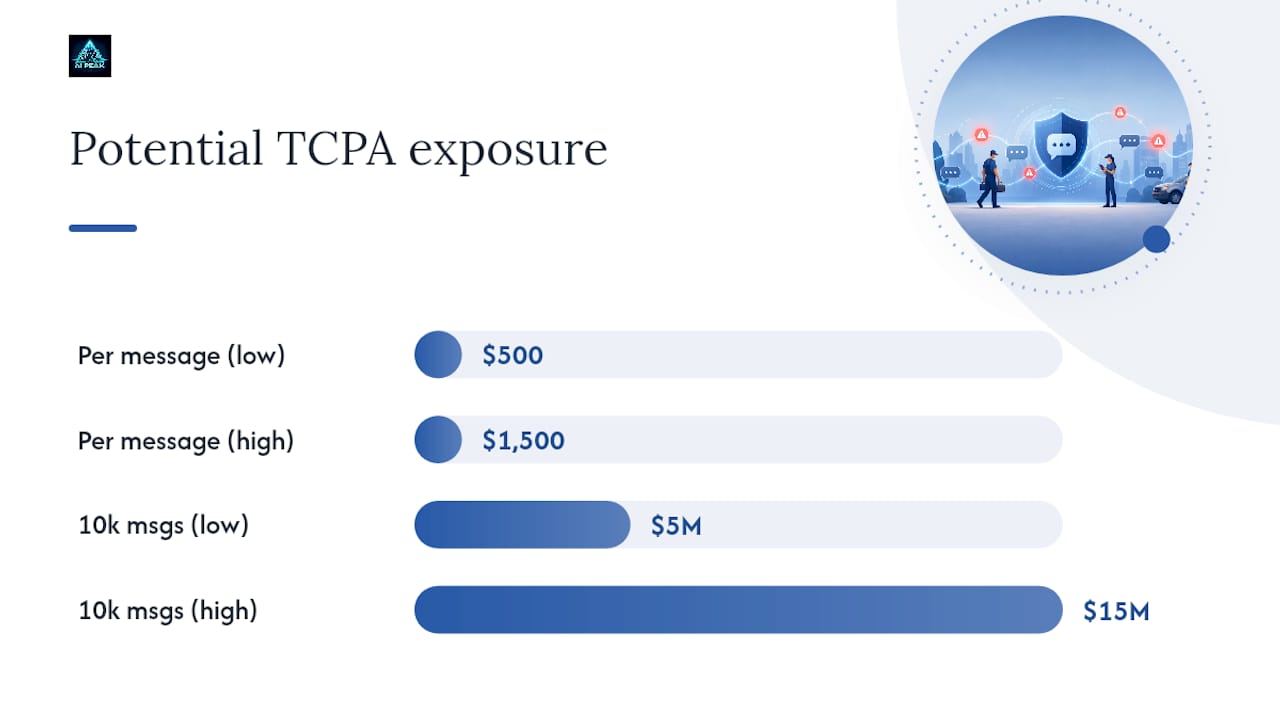
Statutory damages run $500 to $1,500 per violating message, with no aggregate cap on total exposure. A campaign of 10,000 texts sent without valid consent isn't a $500 problem. It can be an expensive one: the TCPA allows damages per message, and class actions multiply that across every recipient.
The FCC's recent Report & Order gives both the agency and private plaintiffs sharper tools. Carriers can now block traffic after formal notice, DNC protections explicitly cover text messages, and the one-to-one consent requirement closes off the "we bought a compliant list" defense that used to shield lead buyers from liability.
Most private class actions trace back to the same handful of triggers: purchasing leads from an aggregator without fresh one-to-one consent, sharing a single consent record across multiple sellers, or simply failing to process opt-outs before the next scheduled send. None of these require malicious intent. Sloppy list management is enough to trigger statutory liability, which is exactly why the compliance checklist earlier in this piece isn't optional busywork. It's the difference between a normal Tuesday and a class-action complaint landing on your desk.
Turning This Into a Project Plan Your Team Can Actually Run
Reading the rules is one thing. Operationalizing them across legal, marketing, and ops teams is where most businesses stall. Break the work into four phases instead of trying to fix everything simultaneously.
- Immediate (this week): Audit your active SMS lists for purchased or aggregated leads, quarantine anything without documented one-to-one consent, and pause any campaign currently mixing promotional content into informational texts.
- Short-term (this month): Update your opt-in forms to capture and display consent language clearly, complete or verify your 10DLC registration through TCR, and patch any gap where opt-outs from one channel fail to suppress numbers in others.
- Medium-term (this quarter): Integrate consent metadata directly into your CRM so every contact record carries its own timestamp, source, and consent type. Automate RND and DNC scrubbing on a recurring schedule instead of a manual one, and train frontline staff on what triggers the marketing consent standard.
- Ongoing governance: Run quarterly compliance audits, build TCPA language into vendor service agreements, and set a formal retention policy so records don't quietly age out or get lost in a platform migration.
The teams that treat this as a one-time cleanup tend to slide back into bad habits within a year. The ones that build it into a recurring quarterly process, similar to how you'd treat a marketing automation audit checklist, stay ahead of both regulators and plaintiffs' attorneys.
Pro Tip: Assign one person, not a committee, as the owner of your consent and suppression data. Shared ownership is how opt-outs slip through the cracks between "marketing thought ops handled it" and "ops thought marketing handled it."
Where AI Peak Biz Sees Businesses Get Tripped Up
Across service businesses working through 10DLC registration, the same three mistakes show up repeatedly: brand records that don't match the business name on file with carriers, program descriptions that are too vague for carriers to classify the traffic, and use-case selections that don't match what the business actually sends (picking "marketing" when the real traffic is appointment confirmations, or vice versa). Each one causes filtering or outright blocking.
The businesses with the cleanest audit trails are usually the ones capturing consent at the point of first contact, inside the same system that logs the interaction. When a missed-call text-back responds instantly to an inbound call, that response and the consent tied to it get timestamped and stored in one place automatically. That's not just faster follow-up. It's cleaner evidence if that consent is ever questioned.
Why Compliance Should Be a Standing Process, Not a Checklist You Run Once
Here's what the conventional advice gets backwards: TCPA compliance isn't a legal chore that sits apart from your marketing performance, it's a quality control system that happens to also keep you out of court. Every consent record you capture cleanly is also a better-qualified lead. Every opt-out you honor promptly is one less person who reports your business as spam, which protects your sender reputation for everyone else on your list.
The businesses that struggle here usually treat compliance as legal's problem and marketing performance as marketing's problem, when they're the same system. Pair your legal review with the operational fixes, consent capture, suppression syncing, carrier registration, and you'll likely see fewer complaints and better response rates at the same time.
How AI Peak Biz Helps With Consent Capture and Audit Trails
Building compliant SMS workflows by hand, consent capture, opt-out routing, suppression syncing, carrier registration, means stitching together tools that were never designed to talk to each other. Service businesses can use platforms that log every inbound call, text, or web chat with a timestamp automatically, creating the audit trail you'd otherwise have to build manually.
The platform's AI chatbot captures consent language at the point of first contact, ties it to a specific campaign, and syncs opt-outs across every channel so a suppressed number in one place stays suppressed everywhere. For businesses still untangling 10DLC registration or building compliant opt-in forms on their site, the website design service can build those forms for you. None of this replaces legal counsel, and any state-specific "mini-TCPA" question should go to an attorney, resources like Oldham Law's business agreement services handle that kind of jurisdiction-specific review well. But if you want the operational side handled so your team stops reconstructing consent trails by hand, check the pricing plans and see which tier fits your call and text volume.
Primary Sources Worth Bookmarking
For the rule language itself, the FCC's Report & Order on unlawful texts is the authoritative source on one-to-one consent and revocation standards. The Federal Register notice summarizes the same rule making in plainer regulatory language. For the underlying statute, consult the FCC's TCPA enforcement pages directly. For carrier-side operational guidance, industry writeups on TCPA compliance and 10DLC explain how CTIA rules affect deliverability separately from federal law.
This article is general information, not a substitute for advice from a qualified lawyer. Consult a qualified legal professional about your own circumstances before acting on anything here.
Sources
- FCC Report & Order (Targeting and Eliminating Unlawful Texts), FCC-23-107A1
- Federal Communications Commission (FCC), TCPA enforcement pages and notices
- Infobip blog, TCPA compliance for SMS