
By AI Peak Biz Team · September 13, 2026
Four Field Capture: Lead Qualification Automation for Services

Lead qualification automation scores, enriches, and routes incoming leads in seconds so high-intent prospects see a booking calendar or the right rep before they lose interest. The system runs on a simple pipeline: capture the lead, enrich the record, score it against your thresholds, and route it automatically to booking, a rep, or a nurture track. Service businesses that build this correctly stop losing revenue to slow follow-up and manual review queues.
TL;DR:
- Automated lead qualification can instantly score and route high-intent prospects; in RevenueHero's 2025 benchmark of B2B software companies, the top 10% booked 78% or more of their qualified leads, against a median of 62%.
- The qualification process relies on four key stages: capturing leads across multiple channels, enriching data with firmographic and behavioral signals, real-time scoring based on thresholds, and immediate routing to bookings or follow-up sequences.
- Effective setup requires locking minimal essential fields, defining clear threshold bands, integrating calendar booking immediately, and testing edge cases before deployment to maximize conversion speed.
- Using just rule-based scoring is often sufficient at low volumes, while AI or hybrid models become advantageous for larger, enterprise-level deal cycles with multiple stakeholders.
- Regular recalibration and tracking of metrics such as speed-to-lead, qualified-to-booked rate, and closed-won lift are vital to ensuring ongoing qualification system effectiveness.
Table of Contents
- What Is Lead Qualification Automation and How Does It Work?
- Which Lead Scoring Model Fits Your Sales Process?
- How Do You Set Up Automated Lead Qualification?
- What Metrics Prove Your Lead Qualification Is Working?
- Should You Use AI or Rule-Based Lead Scoring?
- How AI Peak Biz Puts This Into Practice
- What Most Teams Get Wrong About Qualification Speed
- Automate the Front Desk, Not Just the Follow-Up
- Sources
What Is Lead Qualification Automation and How Does It Work?
Every automated qualification system runs through the same four stages, whether it is guarding a home services company's phone line or a SaaS company's demo request form. Understanding each stage matters more than picking a specific vendor, because the stages determine where leads actually get lost.
Capture happens across more channels than most teams realize: web forms, AI chatbots, call transcription, SMS replies, and social direct messages on platforms like Instagram or Facebook Messenger. A missed call is a capture event too, if the business has a system that logs it and triggers a text back instead of letting it die in a voicemail box.
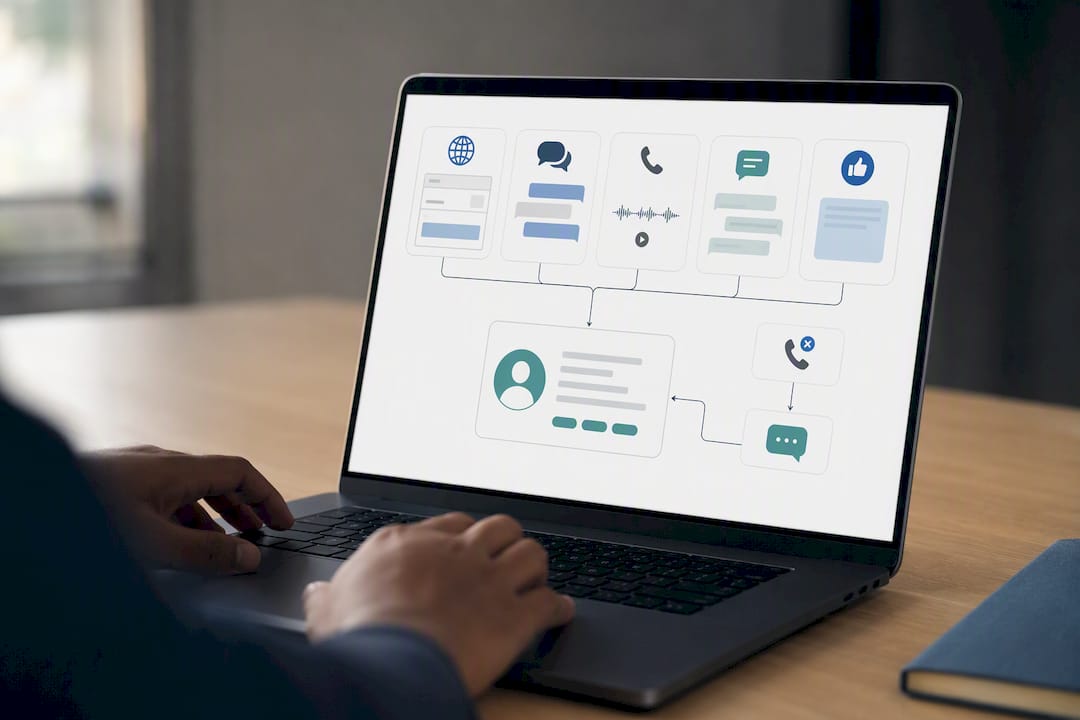
Enrichment adds context the lead didn't type in. This includes firmographic data (company size, industry, location), intent signals from third-party data providers, and CRM history showing whether this contact opened a quote six months ago. Layering form data with enrichment and CRM history at the moment of capture produces more accurate routing decisions than single source approaches, because a single form field rarely tells the whole story.
Scoring happens in real time, often within the same second the lead submits. The system checks the enriched record against threshold logic: does this lead clear the "hot" bar, land in "warm," or fall into "cold" and need nurturing? Highspot's 2026 qualification checklist recommends scoring against fit, intent, authority, timing, pain, and budget rather than a single data point, since a lead with big budget but no urgency behaves very differently from one with tight timing but a smaller deal size.
Routing is the payoff. Here's what that pipeline looks like end to end:
- A lead fills out a form, texts a business number, or chats with an AI assistant.
- The system enriches the record with firmographic and behavioral data in the background.
- A scoring model applies weighted rules or a trained model to generate a live score.
- Hot leads see a booking calendar immediately, or get assigned to a rep by territory or ownership rules.
- Warm leads route to a follow-up sequence with a shorter SLA.
- Cold leads enter a longer nurture cadence, with the option to re-score later based on new behavior.
The feedback loop closes when closed-won and closed-lost outcomes flow back into the scoring model, which is where most teams either get sharper over time or slowly drift out of calibration.
Which Lead Scoring Model Fits Your Sales Process?
Four scoring models dominate current lead qualification, and most mature teams end up blending more than one.
- Demographic and firmographic scoring weighs who the lead is: company size, industry, job title, location. It works well for B2B teams selling into defined verticals but says nothing about urgency.
- Behavioral scoring tracks what the lead does: pages visited, emails opened, chatbot responses, call duration. It catches intent that firmographic data misses entirely.
- Predictive scoring uses machine learning trained on historical closed-won and closed-lost records to project a probability of conversion. Transformer-based models can infer intent from conversation and behavioral signals in real time when trained on representative sales interactions, which makes this model powerful at volume but weaker with a thin data history.
- Account-based scoring aggregates signals across every contact at a target account rather than scoring one lead in isolation, which matters when the buying decision touches five or six stakeholders.
If you're starting from zero, resist the urge to build a ten-factor model on day one. Start with three or four high-impact signals, such as stated timeline, budget range, and one behavioral trigger like a pricing page visit, then add complexity once you have enough closed deals to validate it.
Pro Tip: Attach a "reason code" to every score, such as "high intent (pricing page + demo request) + budget confirmed." Reps trust a scoring system far more when they can see why a lead scored hot instead of taking the number on faith.
Account-based or predictive scoring earns its complexity when you have enterprise deal cycles with multiple buyers, or a lead volume high enough (typically hundreds per month) to keep a predictive model properly trained. Below that volume, rule-based demographic and behavioral scoring is more accurate simply because it isn't guessing from sparse data.
How Do You Set Up Automated Lead Qualification?
Building this system is less about software and more about the decisions you make before you turn it on. Here's the sequence that avoids the most common rollout failures.
- Lock the four essential capture fields. Every qualification flow, whether it's a chatbot, a form, or a phone script, needs primary intent (what they want), fit (do they match your service area and offer), timeline (when they need it), and contact information. A four-turn question stack that asks exactly these four things converts better than a ten-field form because it respects the lead's attention span.
- Design your threshold bands. Define hot, warm, and cold numerically, then write the handoff rule for each: hot books directly on a rep's calendar, warm goes to a rep within a one-hour SLA, cold enters an email or SMS nurture sequence.
- Wire in calendar integration before anything else. The single highest-leverage change in this entire process is turning the form submission itself into a booking event. Teams that present a calendar the moment a lead clears qualification skip the manual review queue entirely, and that operational choice drives the largest conversion gains of any step in this checklist.
- Test edge cases before launch. Run scenarios for account ownership conflicts (existing customer submits a new form), rep PTO coverage, duplicate lead submissions, and leads that arrive through offline channels like a trade show scan.
- Pilot with a defined SLA, then measure. Run the system on a subset of traffic or one territory for two to four weeks, track the metrics below, then expand.
Pro Tip: Audit your CTA language during setup. "Book a demo" and "Request a demo" sound interchangeable, but the commitment framing changes conversion behavior at every capture point, so test both before locking your booking page copy. For more on structuring calendar placement itself, booking page design choices matter as much as the qualification logic feeding into them.
What Metrics Prove Your Lead Qualification Is Working?
Five numbers tell you whether the system is actually earning its place in your stack:
- Speed-to-lead: the time between capture and first meaningful contact or booking offer.
- Qualified-to-booked rate: what percentage of leads that clear your threshold actually land on a calendar.
- Disqualification (DQ) rate: how many leads your rules filter out, and whether that rate is trending up or down.
- Meeting show rate: whether booked meetings actually happen, a number that often exposes a scoring problem upstream.
- Closed-won lift: the real test, measuring whether qualified leads convert to revenue at a higher rate than they did before automation.
Removing the wait between form submission and calendar booking is a high-impact lever: RevenueHero's 2025 analysis of more than one million inbound form submissions found that the top 10% of its customers book 78% or more of their qualified leads, with a median of 62%.
Recalibration should run on a quarterly cadence at minimum. Pull your disqualified lead cohort and check it against actual closed-won results. That audit tends to reveal blind spots where the rules are filtering out an emerging buyer profile nobody accounted for when the thresholds were first set. Ops should own the measurement and dashboards; sales should own the qualitative quality checks, since reps notice a bad lead pattern faster than a spreadsheet does. The SBA's guidance on marketing and sales operations reinforces this split: assign clear ownership for inquiries, or opportunities quietly fall through the gap between departments.
Should You Use AI or Rule-Based Lead Scoring?
Rule-based scoring wins on predictability. You can explain exactly why a lead scored 85 out of 100, which matters when a rep questions a routing decision. It's also cheap to build and doesn't require a data science team to maintain.
AI-driven scoring wins on scale and pattern recognition, catching signal combinations a human rule set would never think to write. The tradeoff is explainability risk: a model can drift as your market changes, inherit bias from historical data, or misroute a lead in ways that are hard to diagnose without reason codes attached.
- Use rule-based bands for early-stage programs or lower lead volume, where explainability and speed of setup outweigh marginal accuracy gains.
- Use AI-driven scoring once you have enough closed-won data to train and retrain a model responsibly.
- Require human approval for high-value or strategic accounts, even inside an otherwise automated pipeline.
- Build an escalation path so a rep can flag a misrouted lead and correct the model's future behavior, not just override the one instance.
The practical answer for most teams is hybrid: automate the volume leads end to end for speed, and keep a human checkpoint on the accounts where a wrong call costs real money.
How AI Peak Biz Puts This Into Practice
AI Peak Biz built its platform around the exact pipeline described above, aimed specifically at local service businesses that need to avoid dropped calls and delayed lead follow-up.
- The AI system answers calls and texts around the clock, asking qualifying questions in real time instead of routing to voicemail.
- Qualified leads see a booking option immediately, syncing straight into the business's CRM and pipeline tracking rather than landing in a spreadsheet someone checks tomorrow.
- Missed call text-back catches the calls a business would otherwise lose entirely, turning a dead end into a captured lead.
- Multi-channel coverage spans SMS, web chat, email, Facebook Messenger, Instagram, and Google Business Profile, so a lead never has to guess which channel actually gets a response.
For teams building out their own qualification scripts, AI Peak Biz's guide on lead qualification questions, scripts, and SLAs walks through the exact prompts to use at capture. The piece on how AI prioritizes contractor leads breaks down routing logic for trades businesses specifically, and the two-way texting guide covers a capture channel most competitors still treat as an afterthought. For a service business owner deciding whether to build this in house or adopt a platform already configured for it, this is the direct, practical option.
What Most Teams Get Wrong About Qualification Speed
Every implementation I've studied has the same failure pattern: teams build a sophisticated scoring model and then bottleneck it behind a human review step that undoes the entire point. Speed is the whole game. Default to the fewest required fields you can get away with, and resist the urge to add a fifth qualifying question just because it seems useful.
The second mistake is tuning thresholds off gut instinct instead of closed-won data. A score that "feels right" to a sales manager is worthless until it's been checked against which leads actually became revenue.
Pilot with a real SLA and a feedback loop before rolling out company wide. And never let automation make the judgment call on a strategic account. Speed serves volume leads. Judgment still belongs to a person when the deal size justifies it.
Automate the Front Desk, Not Just the Follow-Up
AI Peak Biz is the direct alternative to hiring another front-desk employee or letting missed calls quietly drain your pipeline. Instead of a static form or a call center script, AI Peak Biz answers calls and texts fast, asks the qualifying questions this article just walked through, and puts a booking slot in front of a hot lead before they call your competitor.

This isn't a bolt-on chatbot widget. It's built specifically for service businesses in industries like automotive and beauty, where a missed appointment request often means a lost customer for good. AI Peak Biz's AI chatbot handles the conversational qualification piece, while the platform's website design work makes sure the booking calendar actually shows up at the moment a lead is ready to commit. If you run a hair salon, the AI front desk built for hair salons applies this exact playbook to appointment-heavy scheduling.
Sources
- How to Qualify Inbound Leads Automatically
- Lead Qualification Process: The 2026 Sales Checklist
- ArXiv: transformer and intent modeling research
Recommended
- Stop Chasing Dead Leads: Lead Qualification Questions, Scripts and SLAs
- How AI Qualifies Inbound Leads: A 2026 Guide
- AI Chatbot for Contractors: Capture and Convert Website Leads 24/7
- 3 Pipeline Automations to Recover Lost Jobs for Service Businesses
FAQ
What Is Automated Lead Qualification?
Automated lead qualification is a system that scores incoming leads against defined criteria, such as fit, intent, and timing, then routes each one to booking, a rep, or a nurture sequence without manual review.
How Much Is a Qualified Lead Worth?
Value varies widely by industry and deal size, but the bigger lever is conversion rate: how quickly qualified leads get booked.
What Is Lead Qualification in Zapier?
In workflow tools like Zapier, lead qualification typically refers to an automated trigger, such as a form submission, that runs the lead through scoring logic and then routes it to a CRM, calendar, or notification based on whether it clears set thresholds.
What Is a Lead Qualification Process?
A lead qualification process is the defined sequence a business uses to capture a lead, enrich its data, score it against fit and intent criteria, and route it to the appropriate next step, whether that's a booking calendar, a sales rep, or a nurture campaign.