
By AI Peak Biz Team · September 28, 2026
Recover Missed Jobs for Home Services: Email Marketing Plus 24/7 AI
The winning formula is simple: segment your list by lifecycle and service type, run a small set of automated booking-focused flows, and fix your deliverability before you send another campaign. Anchor everything to CAN-SPAM rules and proper SPF, DKIM, and DMARC setup, because a beautiful email that lands in spam books zero appointments. Watch one metric above all others: booked appointments generated per campaign, not just opens.
TL;DR:
- Segmentation by customer lifecycle, service type, and property details is essential to target your emails effectively and increase conversion chances.
- Automated flows such as estimate-to-book, appointment reminders, and reactivation campaigns generate most bookings, especially when escalated promptly with human follow-up.
- Short, targeted subject lines and mobile-optimized content with clear calls to action improve open rates and engagement among home service customers.
- Authentic domain authentication, list maintenance, and compliance with CAN-SPAM significantly boost email deliverability and inbox placement.
- Combining segmentation, automation, and fast multi-channel follow-up is the most reliable method to increase booked jobs and revenue in home services.
Table of Contents
- Who to email and how to segment lists for home services
- High-impact campaign types and one-line templates
- How to write subject lines, preheaders, and body content that convert
- Step-by-step automation flows that turn opens into bookings
- Technical deliverability steps and CAN-SPAM compliance checklist
- Which KPIs matter and sample benchmarks for home services
- What integrated follow-up teaches us about recovering revenue
- What most home service businesses get wrong about email
- How AI Peak Biz fits into your email strategy
- Sources
Who to email and how to segment lists for home services
Sending the same email to every contact on your list is the fastest way to waste a good subject line. Home service businesses convert better when they treat their list like a set of distinct relationships, not one big audience.
Start with five segments that map directly to what each customer needs from you right now:
- New leads: people who requested a quote but haven't booked, needing urgency and reassurance.
- Estimates sent: prospects with a live quote, needing a nudge and a clear next step.
- Booked customers: people with a scheduled job, needing confirmation and prep details.
- Recent customers (0 to 90 days): past clients who are prime candidates for reviews and referrals.
- Lapsed customers (6 to 18 months): past clients due for seasonal service or reactivation offers.
Layer in service-type tags such as HVAC, plumbing, roofing, or landscaping so a furnace-repair customer never gets a lawn-care promotion. Add property tags, too: rental versus owner-occupied changes who make the buying decision, and a service-radius tag keeps you from marketing routes you don't actually run.
Lead source and behavior data sharpen this further. A form field that captures job type, a website visit to your "emergency repair" page, or a click on a financing link all signal how ready someone is to book. Prioritize follow-up based on that signal instead of treating every lead the same.
Pro Tip: Tag leads by the exact page or form they came from. A visitor who filled out an "emergency AC repair" form should get a same-day follow-up, not a weekly newsletter.
High-impact campaign types and one-line templates
Not every campaign deserves equal attention. A handful of automated sequences drive most of the bookings, and the rest is maintenance.
- Welcome series: goal is trust and first booking, triggered on signup, sent over the first week.
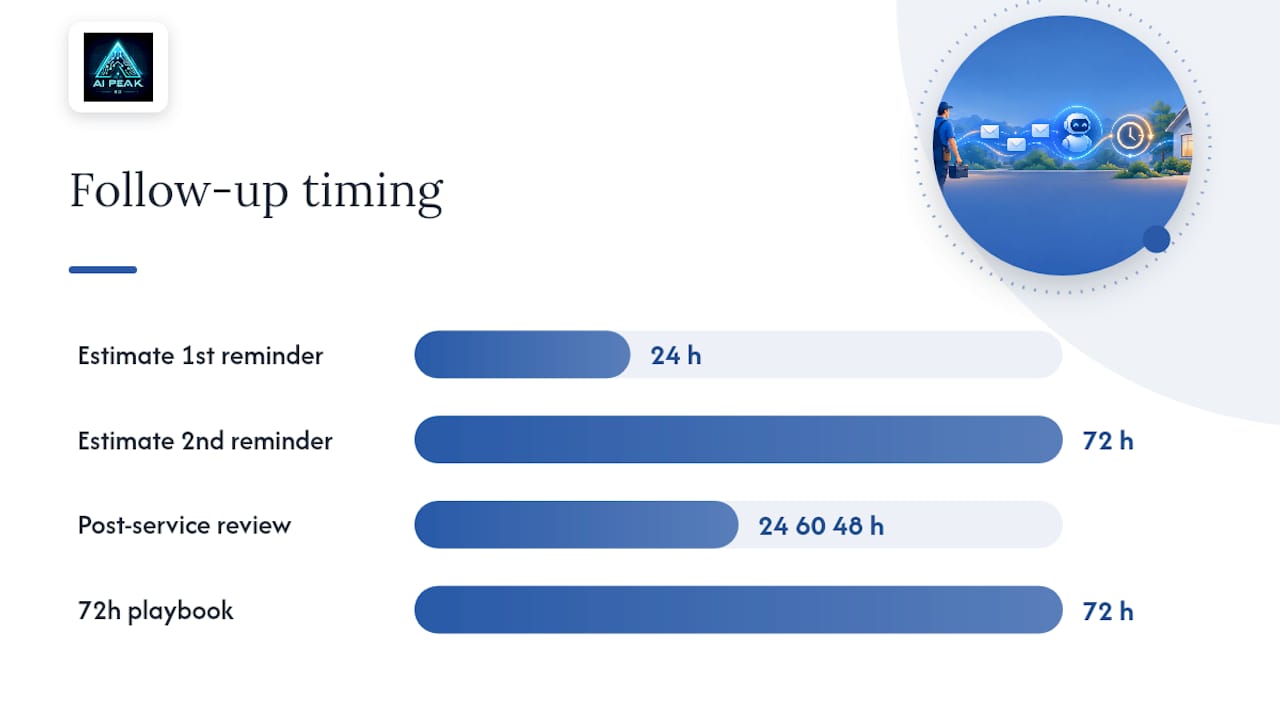
- Estimate-to-book flow: goal is converting a quote into a job, triggered when an estimate is sent, cadence of 24 to 72 hours between nudges.
- Appointment reminders: goal is reducing no-shows, triggered 48 and 24 hours before the job.
- Post-service review requests: goal is reputation and referrals, triggered right after job completion.
- Seasonal maintenance campaigns: goal is proactive bookings, triggered by season or equipment age.
- Reactivation campaigns: goal is winning back lapsed customers, triggered after 6 to 18 months of inactivity.
Each one works best with a short, specific template rather than a generic blast:
- Estimate-to-book: subject "Your quote is ready, [Name]", preheader "Here's what's included", CTA "Book your appointment".
- Appointment reminder: subject "See you Thursday at 2 PM", preheader "Quick prep tips inside", CTA "Add to calendar".
- Review request: subject "How did we do?", preheader "60 seconds, big help", CTA "Leave a review".
Once these flows are live, A/B test one variable at a time. Subject lines are the first thing to test, since they decide whether the email gets opened at all, and send timing comes second once your open rates stabilize.
How to write subject lines, preheaders, and body content that convert
Home service customers are usually reading email on a phone between jobs, errands, or dinner. Your subject line has to work in the roughly 30 to 40 characters visible on a locked screen.
A few formulas earn opens consistently:
- Local signal: "Your [neighborhood] estimate is ready".
- Benefit-first: "Cut your winter heating bill".
- Urgency: "Last call: book before the freeze".
- Estimate-ready: "[Name], your quote just landed".
The preheader is free real estate that most businesses waste by repeating the subject line. Use it to add a second reason to open, like "See pricing and available dates inside."
Inside the email, give each message one job. An estimate-follow-up email shouldn't also try to sell a maintenance plan. Include a short line of social proof, a photo of completed work if you have one, and one or two clear calls to action, never five competing buttons. Keep the layout mobile-first: single column, large tap targets, and alt text on every image so the message still makes sense if images don't load.
Pro Tip: Put your primary CTA button above the fold. Most home service customers decide whether to act within the first few seconds of opening.
Step-by-step automation flows that turn opens into bookings
Automation is what separates a newsletter from a booking engine. These four flows cover the moments that matter most in a home service customer's life cycle.
- Welcome series: three emails over 7 to 10 days. Email one introduces the business and sets expectations, email two shares a customer story or before-and-after, email three offers a small incentive to book a first service.
- Estimate-to-book flow: triggered the moment an estimate is sent. Send a reminder at 24 hours, a second at 72 hours with a testimonial or added detail, and if the estimate is still unbooked, escalate to a text message or phone call rather than a third email.
- Post-service sequence: send the invoice or receipt immediately, follow with a review request within 24 to 48 hours, then a simple referral ask a week later. A cross-sell email for a related service can follow two to three weeks out.
- Reactivation flow: target anyone inactive for 6 to 18 months with a seasonal check-up offer or a small discount, sent in two attempts about a week apart before moving the contact to a lower-frequency list.
A 72 hour follow-up playbook built for marketplace leads shows how tightening the estimate-to-book window, especially the escalation to a call or text, directly increases booked jobs.
Pro Tip: If an estimate goes unbooked after your second email, hand it to a person or an automated call system instead of sending a third email. Silence usually means the lead needs a human touch, not another message.
Technical deliverability steps and CAN-SPAM compliance checklist
None of the flows above matter if your emails never reach the inbox. Deliverability and compliance are the foundation, not an afterthought.
On the legal side, the FTC's CAN-SPAM compliance guide lays out the core requirements: accurate header information, a valid physical postal address in every email, and a clear, working opt-out link. CAN-SPAM does not require prior opt-in, but it does require you to honor opt-out requests promptly, and deceptive subject lines are against the rules.
On the technical side, authentication is the highest-leverage fix available. A 2025 deliverability benchmark report found that fully authenticated domains, meaning SPF, DKIM, and DMARC set to enforcement, achieved 85% to 95% inbox placement, while only 7.6% of domains actually enforce DMARC.
Only a small minority of domains enforce DMARC, and unauthenticated senders can face a significant deliverability penalty compared to mature, authenticated domains. That gap is often the real reason a campaign underperforms, long before subject lines or content come into play.
Keep your list clean with these habits:
- Verify email addresses before every campaign, or at minimum monthly.
- Remove hard bounces immediately to protect your sender reputation.
- Re-engage inactive subscribers with a short win-back attempt, then sunset anyone still unresponsive after 6 to 12 months.
- Avoid sudden volume spikes on a new domain, and plan for domain aging if you expect to scale sending later this year.
Deliverability behaves like a system: authentication, list quality, and sending patterns all have to work together, since fixing only one rarely restores inbox placement on its own.
Which KPIs matter and sample benchmarks for home services
Tracking the right numbers keeps you from celebrating a high open rate while bookings stay flat.
The core metrics to watch are open rate, click-through rate, click-to-book conversion, booked-appointment rate, and unsubscribe or complaint rate. Calculate click-to-book by dividing booked appointments from email by total clicks, and treat that number, not opens, as your real performance indicator.
Benchmark Email's industry data shows open rates vary widely by sector, with facility-services and residential real estate verticals reporting rates in the high 20s to low 30s, a solid target range for a service business with a clean, relevant list.
| Metric | What it tells you |
|---|---|
| Open rate | Whether subject lines and sender reputation are working |
| Click-through rate | Whether content and CTAs are relevant |
| Click-to-book conversion | Whether the booking process itself converts clicks |
| Unsubscribe/complaint rate | Whether frequency or relevance is off |
Build a simple monthly dashboard that lists sends, opens, clicks, and booked jobs side by side for each flow, so you can see which sequence is actually filling the schedule. Tag booked jobs in your CRM with the campaign source, since that link between email and revenue is the number that matters most to your bottom line.
What integrated follow-up teaches us about recovering revenue
Email flows work best when they don't operate alone. A Mailchimp case study on segmentation and automated flows documented a 58.7% welcome-series open rate and a reported 30x revenue return, a reminder that segmentation paired with triggered follow-ups is one of the most repeatable ways to lift both engagement and revenue.
For home service businesses, that same logic extends past the inbox. A customer who doesn't open your estimate-follow-up email might still answer a phone call or reply to a text within minutes. Instant AI call and text response reduces that lost opportunity by catching the lead the moment email alone doesn't close the gap, especially for time-sensitive jobs like a broken water heater or a failed AC unit.
An integration checklist worth following:
- Connect your email service provider to your CRM or unified inbox so lead status updates automatically.
- Set escalation rules so an unbooked estimate triggers an SMS or call after a defined window.
- Track appointment-booked events back to the original campaign so you know which flow earned the job.
Segmentation plus automated flows, backed by fast follow-up across every channel, is the most repeatable path to higher conversion for a service business.
What most home service businesses get wrong about email
The biggest mistake in home service email marketing isn't a weak subject line. It's treating email as a standalone channel instead of one piece of a response system. A perfectly segmented list with flawless deliverability still loses jobs if the estimate-to-book flow ends at the third email with no escalation to a human or a phone call.
Conventional advice leans hard on open rates and design polish, but those numbers rarely correlate with booked jobs on their own. What actually moves revenue is the handoff: the moment an email doesn't convert and something else, a text, a call, a person, picks up the thread within hours, not days.
If you take one thing from this guide, prioritize the estimate-to-book window and the reactivation flow over redesigning your newsletter. Those two sequences touch revenue directly, and they're the ones most businesses leave on autopilot instead of watching closely.
How AI Peak Biz fits into your email strategy
Every flow in this guide assumes someone or something is ready to catch the leads email doesn't convert on its own, and that's exactly the gap AI Peak Biz was built to close. Instead of juggling separate tools for calls, texts, booking, and follow-up, AI Peak Biz puts them in one place: on Ascent an AI voice agent can answer calls and book appointments by phone, and on Summit missed-call text back can reply within moments, so an unopened estimate email doesn't have to mean a lost job.

- It complements your estimate-to-book flow by catching leads who don't click through email with an instant call or text response instead.
Plans are named AI Website, Base Camp, Ascent, and Summit, with pricing detailed on the AI Peak Biz pricing page. If your emails are booking jobs but your phone lines and texts are still going unanswered after hours, take a look at what an integrated system can recover.
Sources
- CAN-SPAM Act: A Compliance Guide for Business | Federal Trade Commission
- B2B Email Deliverability Report 2025: Inbox Rates, DMARC & ESP Trends
- Email marketing benchmarks | Benchmark Email
- How Vårdväskan uses personalization tools to achieve 30x ROI | Mailchimp
Recommended
- 3 Pipeline Automations to Recover Lost Jobs for Service Businesses
- Missed Call Text-Back for Contractors: How It Works and Why You Need It
- Cut No Shows Fast: Three Message SMS Reminders for Small Businesses
- AI in Home Service Businesses: Your 2026 Guide
FAQ
What is the 3-3-3 rule for marketing?
Definitions vary across marketing circles, and no single sourced definition applies specifically to home service email campaigns. Rather than force-fitting a generic rule, focus on the segmentation and automation flows outlined above, which have documented outcomes for service businesses.
What is the average cost of email marketing services?
Pricing depends heavily on list size, the platform chosen, and whether you're paying for a standalone email tool or a bundled automation platform. AI Peak Biz offers plans from $197 per month on the AI Website plan up to $597 per month on the Summit plan, which include email and SMS campaigns alongside AI call and text response.
What are some effective marketing ideas for home care services?
Seasonal maintenance reminders, post-service review requests, and reactivation offers for lapsed customers consistently perform well because they target people who already know your business. Pairing these email flows with fast phone and text follow-up helps convert engagement into actual bookings rather than just opens.
What is the 80/20 rule for email marketing?
A small share of your campaigns or segments typically drive most of your results, which lines up with what home service data shows: estimate-to-book flows and reactivation campaigns tend to outperform generic newsletters. Prioritizing those high-impact flows over broad, unsegmented sends is the more reliable use of limited marketing time.