
By AI Peak Biz Team · October 2, 2026
Consent-First Email and SMS Nurture for Service Owners

Yes, add SMS to your email nurture, but only for time-sensitive or high-intent moments where you have documented consent and a clear trigger. Email stays your workhorse for education and long-form content. SMS earns its place when speed matters: booking confirmations, missed-call recovery, appointment reminders. Treat every text as a compliance event, log consent, and measure incremental lift before you scale.
TL;DR:
- Use SMS only for urgent, time-sensitive, or high-intent moments with documented consent, such as confirmations or reminders, to lower your legal risk.
- Combine email and SMS to cover different stages of the lead journey, with email handling detailed content and SMS driving immediate actions or confirmations.
- Gather and log clear consent separately for informational and promotional messages, maintaining records and honoring opt-outs to comply with FCC rules and TCPA regulations.
- Sequence messages based on trigger events like form submissions, missed calls, or bookings, keeping SMS cadences low and time-zone appropriate to avoid overwhelming recipients.
- Implement automation and suppression controls through an integrated platform to maintain deliverability, compliance, and accurate attribution across channels.
Table of Contents
- Why combine email and SMS for lead nurture
- When to use SMS vs email: message types and short examples
- Consent, compliance, and carrier rules you can't skip
- Sequencing and triggers: stitching email and SMS into one flow
- Segmentation and personalization that reduce opt-outs
- Deliverability and technical checklist for both channels
- Measurement, testing, and attribution for multi-channel nurture
- Implementation checklist and copy templates you can use today
- How an integrated AI platform handles these checklists in practice
- When I'd add SMS first, and what I'd pause on
- Put these workflows to work with AI Peak Biz
- Sources
Why combine email and SMS for lead nurture
Email and SMS solve different problems, and that is the whole case for using both. Email gives you room to explain, to tell a story, to walk a lead through a decision over days. SMS gives you a few seconds of someone's full attention, which is why it works so well for moments that can't wait.
The two channels cover different intents inside the same nurture journey. A prospect reading your onboarding email is in learning mode. A patient confirming tomorrow's appointment is in action mode. Trying to force one channel to do both jobs wastes the strength of each.
Combined campaigns tend to show up in a few proven use cases:
- Welcome and onboarding sequences, where email carries the detail and SMS confirms key steps.
- Cart or booking recovery, where a short text nudges someone back before the window closes.
- Appointment reminders, which cut down on no-shows when timed close to the slot.
- Missed-call recovery, texting back instantly when a call goes unanswered.
- Trial-to-paid nudges, where a text reinforces an email deadline.
Done well, the combination shows up as faster responses, better appointment show rates, and a real conversion lift, as long as you're testing for it rather than assuming it.
When to use SMS vs email: message types and short examples
Picking the right channel starts with naming the message type, because each type carries its own consent requirement.
-
Transactional or informational messages confirm something the recipient already expects, like a booking time or a password reset. These carry a lower consent bar since they're tied to an existing relationship or transaction.
-
Promotional messages sell something, a discount, a new offer, a reason to buy now. These require prior express written consent under federal rules, full stop.
-
Conversational messages invite a two-way exchange, like a lead replying to confirm interest or ask a quick question. Treat these like promotional unless the reply is clearly transactional in nature.
SMS wins for anything urgent and short: a reminder, a confirmation, a one-line call to action. Email wins for anything that needs context: a welcome sequence, a comparison, a case for why someone should act.
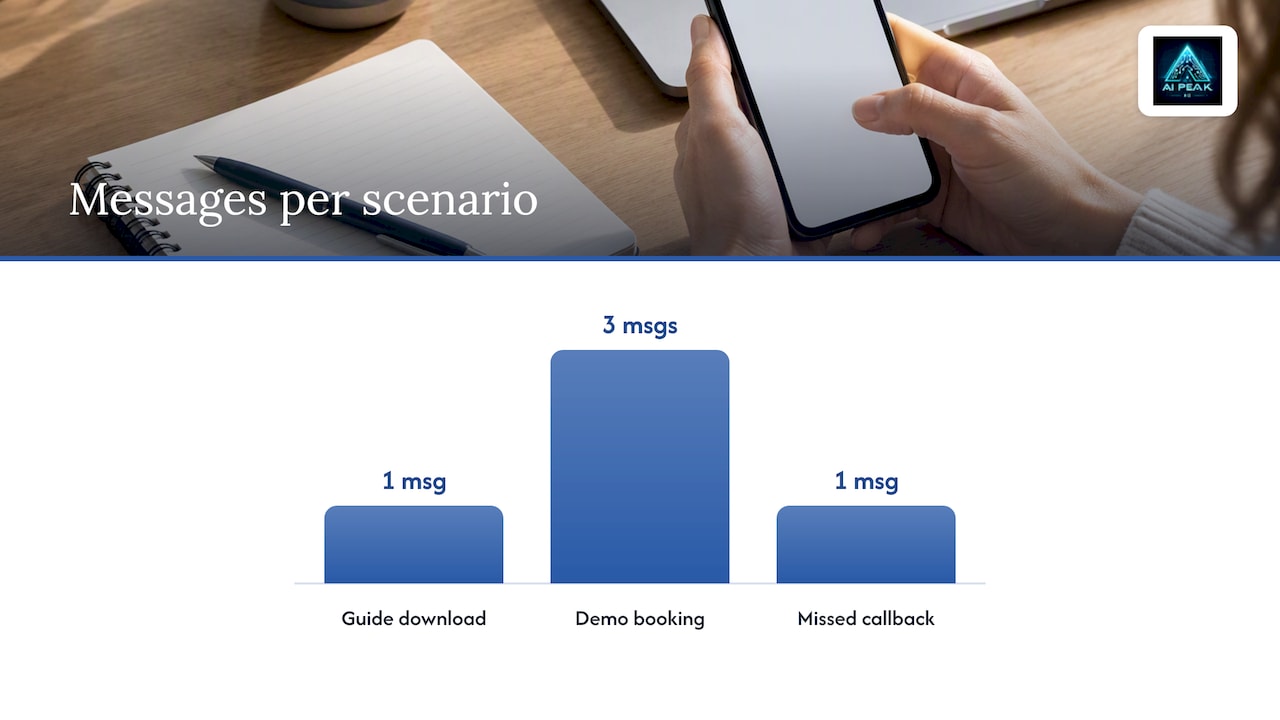
A few quick scenarios make the split concrete. A lead downloads a guide: start with email. They book a demo: confirm by SMS and email, then remind by SMS the day before. They miss your call back: text immediately, since that's the moment speed matters most.
Consent, compliance, and carrier rules you can't skip
Before a single promotional text goes out, your consent process needs to hold up. The FCC's rules require prior express written consent for promotional texts sent with an autodialer, and that consent must name the sender, describe the types of messages, state the frequency, and confirm that consent isn't a condition of purchase. Informational messages, tied to an existing transaction, carry a lighter bar, but the line between the two gets scrutinized closely.
Pro Tip: Keep informational and promotional consent as two separate checkboxes, never one blanket opt-in.
SMS open rates run around 98% compared with roughly 20% for email, but every promotional text sent without documented consent risks statutory damages under the TCPA, which can run $500 to $1,500 per message. That gap is exactly why consent logging matters more than open rates.
Build your checklist around these non-negotiables:
- Collect and timestamp consent at the point of signup, with the disclosure language saved alongside it.
- Honor STOP and other reasonable opt-out language immediately, and keep a record of every revocation.
- Register your sending numbers for 10DLC, since carriers filter and block unregistered traffic.
- Maintain a suppression list that both email and SMS systems check before every send.
One more wrinkle worth flagging: after the FCC's one-to-one consent clarification, consent gathered through a lead generator that lists multiple "marketing partners" is unlikely to count as valid written consent for your business specifically. If your leads come from third-party forms, check the consent language line by line.
Sequencing and triggers: stitching email and SMS into one flow
The right sequence depends on the trigger, not the calendar. Build flows around real events: a form submission, an abandoned booking, a missed call, a completed purchase. Each trigger tells you which channel to use first and how fast to follow up.
- Form submit: send a welcome email immediately, then a confirmation text only if the form included a booking or appointment request.
- Abandoned booking: email within an hour, follow with a short SMS nudge four to six hours later if there's been no action.
- Missed call: text back within a minute, since that's the single highest-value SMS trigger in a service business.
- Appointment booked: confirm by SMS immediately, then remind by SMS the day before, timed to the recipient's local morning rather than a blanket send time.
Cadence matters as much as the trigger. Cap SMS frequency low, generally no more than one or two texts a week outside of transactional confirmations, and never send outside daytime hours in the recipient's own time zone.
Pro Tip: Space your welcome sequence so email carries days one, three, and seven, while SMS only steps in for a same-day confirmation or a time-sensitive nudge. For a closer look at reminder cadence specifically, this breakdown of SMS appointment reminders walks through a three-message structure that holds up well for service businesses.
Segmentation and personalization that reduce opt-outs
Relevance is what keeps people subscribed, and relevance starts with segmentation. Group leads by source, by intent signal, by how recently they engaged, and by what they actually came looking for. A lead who just booked a consultation needs a different message than one who downloaded a guide six weeks ago and went quiet.
- Segment by lead source so a paid-ad lead and a referral lead get different first touches.
- Segment by recency, since a cold lead needs re-engagement, not a booking reminder.
- Segment by product interest or job-to-be-done to keep content relevant.
Personalization should scale with the channel. Email can carry a name, a product reference, a tailored recommendation. SMS should stay lean: a name, one contextual detail, one clear call to action. Overloading a text defeats the purpose of the channel.
Suppression logic has to sit underneath all of it. Anyone who opted out of marketing texts should never see a promotional SMS again, even if they're still active on email. The two channels need a shared source of truth for consent status, checked in real time before every send.

Deliverability and technical checklist for both channels
Getting the message written is only half the job. Getting it delivered depends on technical hygiene most marketers overlook until something breaks.
- Authenticate every email domain with SPF, DKIM, and DMARC, since Gmail requires bulk senders to meet these standards along with one-click unsubscribe support through List-Unsubscribe headers.
- Monitor spam complaint rates through Postmaster Tools, especially if you're sending 5,000 or more messages a day.
- Register SMS campaigns for 10DLC before launch, since carriers filter unregistered traffic without warning.
- Keep SMS content carrier-friendly: avoid shortened links from unfamiliar domains and process STOP replies in real time.
- Clean your list regularly: remove hard bounces, filter out landlines before texting, and keep consent records on hand for audits.
Email and SMS unsubscribe handling has to work in tandem. A complaint on one channel should update suppression status across both, or you'll burn trust fast.
Measurement, testing, and attribution for multi-channel nurture
The numbers that matter most are the ones tied to revenue, not vanity metrics. Track conversions per lead, appointment-held rate, and revenue per lead as your core KPIs, since open rates alone don't tell you whether SMS is earning its place in the sequence.
- Run a holdout group, email-only against email-plus-SMS, to measure the actual lift SMS adds rather than assuming it.
- Keep groups separate enough that attribution stays clean: overlapping sends muddy the data.
- Track complaint and unsubscribe rates by channel, since a rising complaint rate on SMS can quietly damage your sender reputation on email too.
- Review delivery metrics monthly, since carrier filtering changes without notice.
A holdout test doesn't need to be complicated. Route a small, random share of eligible leads to email-only, send the rest your full combined sequence, and compare conversion and complaint rates side by side.
Implementation checklist and copy templates you can use today
Before launch, run through a short legal and QA pass:
- Confirm consent language names your business, describes message types and frequency, and states that consent isn't a purchase condition.
- Test every send path end to end, including STOP handling and suppression list updates.
- Confirm time zone logic so no text goes out before 8 a.m. or after 9 p.m. local time.
A few starting templates, written to be adapted rather than copied verbatim:
- Welcome SMS: "Hi [name], thanks for reaching out to [business]. Reply STOP anytime to opt out. We'll follow up by email with next steps."
- Appointment reminder: "Reminder: your appointment with [business] is tomorrow at [time]. Reply C to confirm or call us to reschedule."
- Missed-call recovery: "Sorry we missed your call. This is [business], how can we help? Reply here or call us back anytime."
After launch, check delivery rates, complaint rates, and conversion numbers weekly for the first month, then monthly after that. A sequence that performs well at launch can drift if consent records or suppression lists aren't maintained.
How an integrated AI platform handles these checklists in practice
An all-in-one AI communications platform can operationalize most of this checklist automatically rather than leaving it to manual review. An all-in-one AI communications platform can provide AI-driven call and text response, lead qualification, and appointment booking built to catch leads the moment they reach out, day or night.
- Instant AI responses to missed calls and texts, so the highest-value trigger in this guide runs without a human watching the inbox.
- Consent and timestamp logging built into the lead capture flow.
- Suppression list enforcement across the unified inbox, so a text opt-out updates everywhere at once.
- Time-zone-aware send logic for reminders and follow-ups.
When I'd add SMS first, and what I'd pause on
I recommend SMS first wherever a missed response costs a booking: missed calls, appointment confirmations, time-boxed offers. I'd pause on SMS entirely if consent capture isn't airtight or your lead data is messy. Fix consent logging before you scale anything else.
Put these workflows to work with AI Peak Biz
Everything in this guide, consent logging, instant response, booking confirmations, suppression handling, is exactly what an integrated AI automation platform can be built to automate for local service businesses. Instead of stitching together multiple tools to cover calls, texts, booking, and follow-up, such a platform can answer every missed call or text instantly, qualify the lead, and book the appointment, all inside one unified inbox.
If you're weighing whether this fits your business, a demo is the fastest way to find out. Ask specifically how consent and suppression data sync across channels, since that's the detail that separates a real compliance safeguard from a feature list. You can explore plans and get started at AI Peak Biz.
Sources
- Text messaging for business marketing: the complete… | LeadCompliant
- Federal Register / Vol. 89, No. 18 / Rules and Regulations
- SMS Compliance & TCPA Text Message Rules (2026) | Enzo
- Email sender guidelines FAQ - Gmail Help
Recommended
FAQ
What is a nurture email?
A nurture email is part of an automated sequence designed to build trust and move a lead toward a decision, usually triggered by an action like a signup or download. It typically delivers education, social proof, or a relevant offer over several touches rather than a single pitch.
Does email to SMS still work?
Email-to-SMS gateways still function technically, but they're unreliable for marketing because carriers increasingly filter gateway traffic and delivery isn't guaranteed. A dedicated SMS platform with proper 10DLC registration is the more dependable route for business texting today.
What is an SMS email?
The term usually refers to sending a text message through an email-to-SMS gateway, where a message addressed to a carrier-specific email domain arrives as a text on the recipient's phone. It's distinct from true SMS marketing platforms, which offer consent tracking, delivery reporting, and compliance tools that gateways don't.
Is B2B texting legal?
B2B texting is legal, but it still falls under the same consent rules as consumer texting when the message is promotional in nature. Informational texts tied to an existing business relationship carry a lighter consent bar, while marketing texts require documented prior express written consent regardless of whether the recipient is a business or a consumer.